If you’re considering A-Levels, one of the first questions you might ask is: What grades do you need to do A-Levels? Entry requirements vary by school, but most institutions require at least five GCSEs at Grade 4/C or above, with higher grades (Grade 6 or 7) needed for competitive subjects like Mathematics and Sciences.
Some top-tier schools and colleges may have stricter criteria, especially for students aiming for medicine, engineering, or law.
Ignite Training Institute is Dubai’s leading tutoring center, specializing in IB, IGCSE, A-Levels, and AP preparation. With a team of highly qualified tutors, we provide personalized learning plans, expert subject guidance, and proven exam strategies to help students excel in their academics.

What Grades Do You Need To Do A Levels From IGCSE, IB, ISC, Or CBSE Background?
A-Levels are a critical stepping stone for students aiming for higher education, particularly in the UK. Entry requirements for A-Level programs can vary depending on the educational background of the student.
Below is an overview of the typical grade expectations for students coming from IGCSE, International Baccalaureate (IB), Indian School Certificate (ISC), and Central Board of Secondary Education (CBSE) backgrounds.
1. IGCSE (International General Certificate of Secondary Education):
- General Requirements: Most institutions expect students to have a minimum of five IGCSE subjects passed at grade C (or grade 4) or above, including Mathematics and English Language. Additionally, achieving higher grades in subjects you wish to pursue at A-Level is often recommended.
2. IB (International Baccalaureate) Middle Years Programme:
- General Requirements: Students completing the IB Middle Years Programme and transitioning to A-Levels are typically expected to have strong performance in their subjects, especially those they intend to study at A-Level. While specific grade conversions can vary, achieving at least a grade 5 or higher in relevant subjects is advisable.
3. ISC (Indian School Certificate) and CBSE (Central Board of Secondary Education):
- General Requirements: For students from ISC and CBSE backgrounds, A-Level program entry requirements can differ among institutions. Some schools may require a minimum percentage in Standard X examinations, often around 70-80%, with higher marks in subjects relevant to the chosen A-Level courses. It’s essential to check with the specific institution for precise requirements.
Additional Considerations:
- Subject-Specific Requirements: Higher grades may be required in specific subjects if you plan to pursue them at A-Level. For example, a strong performance in IGCSE Mathematics would be necessary for A-Level Mathematics.
- Variability Among Institutions: Entry criteria can vary significantly between schools and colleges. It’s crucial to consult the admissions guidelines of the specific institution you’re interested in to understand their exact requirements.
- Alternative Pathways: If you do not meet the standard entry requirements, some institutions offer foundation programs or bridging courses to help students transition into A-Level studies.
Related: A-Level Grading System Explained: From A* To E & Beyond

Subject-Specific Grade Requirements For A-Levels
A-Levels are academically rigorous, and most schools and colleges have specific grade requirements for different subjects. While the general requirement is usually five GCSEs (or equivalent) at Grade 4/C or above, some subjects have stricter criteria, especially in science, mathematics, and competitive courses.
1. Science & Mathematics Subjects
- Mathematics & Further Mathematics
- A minimum Grade 6 or 7 in GCSE Mathematics (or equivalent) is often required.
- Further Mathematics usually demands Grade 7 or higher in GCSE Mathematics.
- A minimum Grade 6 or 7 in GCSE Mathematics (or equivalent) is often required.
- Biology, Chemistry, and Physics
- Most institutions expect at least Grade 6 or 7 in these subjects at GCSE.
- Some schools also require a strong pass in Mathematics (Grade 5 or higher) due to its relevance in scientific calculations.
- Most institutions expect at least Grade 6 or 7 in these subjects at GCSE.
2. Humanities & Social Sciences
- History
- Typically, a Grade 5 or higher in GCSE History is recommended, though some schools allow entry without prior study if the student has strong English skills.
- Typically, a Grade 5 or higher in GCSE History is recommended, though some schools allow entry without prior study if the student has strong English skills.
- Geography
- A minimum of Grade 5 or 6 in Geography is often expected.
- A minimum of Grade 5 or 6 in Geography is often expected.
- Psychology & Sociology
- Most institutions accept students with a Grade 5 or above in English and Mathematics, as these subjects involve essay writing and statistical analysis.
3. Language & Literature Subjects
- English Literature & English Language
- A Grade 6 or higher in GCSE English Literature and English Language is usually required.
- A Grade 6 or higher in GCSE English Literature and English Language is usually required.
- Modern Foreign Languages (e.g., French, Spanish, German)
- Most colleges require at least Grade 6 in the respective language at GCSE.
4. Business & Economics
- Business Studies
- No specific GCSE subject requirement, but a Grade 5 or above in Mathematics and English is preferred.
- No specific GCSE subject requirement, but a Grade 5 or above in Mathematics and English is preferred.
- Economics
- A Grade 6 or higher in Mathematics is often required due to the subject’s quantitative nature.
5. Creative & Performing Arts
- Art & Design
- Students are expected to have a Grade 5 or higher in GCSE Art or submit a portfolio.
- Students are expected to have a Grade 5 or higher in GCSE Art or submit a portfolio.
- Music
- A Grade 5 in Music and the ability to play an instrument (Grade 4-5 standard) are typically required.
- A Grade 5 in Music and the ability to play an instrument (Grade 4-5 standard) are typically required.
- Drama & Theatre Studies
- Schools may expect a Grade 5 or higher in GCSE Drama or strong English skills.
What If You Don’t Meet the Requirements?
- Some schools may allow students to take an A-Level subject even if they don’t meet the exact requirements, provided they demonstrate strong skills in related subjects.
- Alternative routes, such as foundation programs or BTEC qualifications, may be available for students who don’t meet the entry criteria.
Related: Top 10 A-Level Schools In Dubai: Recent Reviews & Insights
Importance Of Choosing The Right A-Levels Subjects
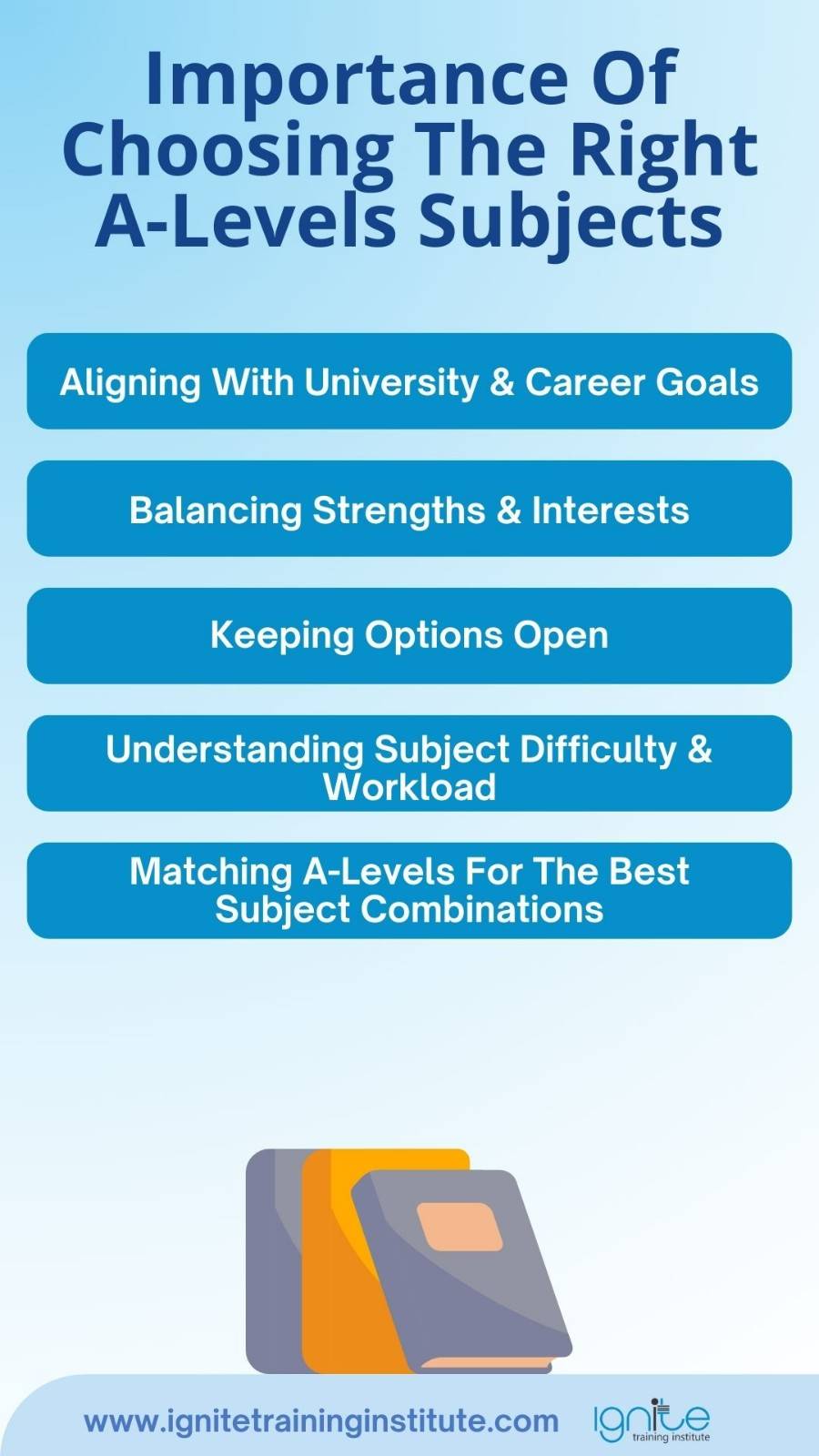
A-Levels are a crucial academic milestone that can shape your future education and career path. The subjects you choose will influence your university options, career prospects, and even your enjoyment of studies. That’s why selecting the right A-Level subjects requires careful consideration.
1. Aligning with University & Career Goals
Many universities have specific subject requirements for different courses. Choosing the wrong A-Levels could limit your options. For example:
- Medicine & Dentistry require A-Levels in Biology and Chemistry (some universities may also require Mathematics or Physics).
- Engineering often requires Mathematics and Physics.
- Law doesn’t have strict subject requirements, but English Literature and History are highly regarded.
- Business & Economics may require Mathematics at higher-ranked universities.
Tip: If you have a specific career in mind, check university entry requirements before finalizing your A-Level subjects.
2. Balancing Strengths & Interests
It’s important to pick subjects that you are both strong in and interested in. Studying something you enjoy can lead to better motivation and higher grades. Consider:
- Were you naturally good at the subject in GCSEs or equivalent exams?
- Do you enjoy the content and find it engaging?
- Can you handle the coursework and exam style?
Avoid choosing a subject solely because:
- Your friends are taking it.
- You think it’s “easy” (most A-Levels are challenging).
- It has a reputation for being “high-scoring” if you don’t actually enjoy it.
3. Keeping Options Open
If you’re unsure about your career path, choosing a balanced mix of subjects can help keep your options open. Some universally respected A-Levels (also known as “facilitating subjects”) include:
- Mathematics
- Sciences (Biology, Chemistry, Physics)
- English Literature
- History & Geography
- Languages (French, Spanish, German, etc.)
These subjects are valued by top universities and offer flexibility in future career choices.
4. Understanding Subject Difficulty & Workload
Some A-Levels are more content-heavy or require strong analytical skills. Subjects like Further Mathematics, Physics, and Chemistry demand strong problem-solving abilities, while English Literature and History involve a lot of essay writing.
Before committing, research:
- The syllabus and exam format.
- Coursework requirements (if any).
- The teaching style and assessment method.
5. Matching A-Levels for the Best Subject Combinations
Certain subjects complement each other well and can help you perform better academically. Examples include:
- Physics + Mathematics + Further Mathematics (Ideal for Engineering or Physics degrees)
- Biology + Chemistry + Psychology (Useful for Medicine, Biomedical Sciences)
- Economics + Business Studies + Mathematics (Great for Finance, Business, Economics)
Avoid combinations that don’t support your goals unless you have a clear reason for taking them.
Related: How To Get A In A-Level With These Proven Tips & Strategies
How Do Different Schools & Colleges Have Varying Criteria?
When applying for A-Levels, students often find that entry requirements can vary significantly between different schools and colleges. While most institutions follow a general guideline, individual schools set their own criteria based on factors like academic rigor, subject demand, and institutional reputation. Here’s how and why A-Level admission requirements differ.
1. General Entry Requirements vs. Institution-Specific Criteria
Most schools and colleges require students to have a minimum of five GCSEs (or equivalent) at Grade 4/C or above, including Mathematics and English. However, selective institutions and high-performing schools often have higher grade expectations and additional subject-specific conditions.
Key Differences in Entry Criteria:
- Selective Sixth Forms & Grammar Schools
- Require at least Grade 6 or 7 in GCSEs.
- May have stricter subject-specific entry rules (e.g., a Grade 7 or 8 in Mathematics for A-Level Mathematics).
- Competitive subjects like Sciences and Further Mathematics often require higher grades.
- Require at least Grade 6 or 7 in GCSEs.
- Independent & Private Schools
- Some private institutions expect students to have an average of Grade 6 or above across all subjects.
- They may also assess students through entrance exams or interviews to evaluate their academic potential.
- Some private institutions expect students to have an average of Grade 6 or above across all subjects.
- State Schools & Sixth Form Colleges
- Offer more flexibility and typically require a minimum of Grade 4 or 5 in GCSE subjects.
- May allow students with lower grades to take A-Levels if they show strong motivation and potential.
- Offer more flexibility and typically require a minimum of Grade 4 or 5 in GCSE subjects.
- International Schools & Colleges
- Accept students from different curricula (e.g., IGCSE, IB, CBSE, ISC) and set equivalent grade requirements.
- Some institutions consider holistic factors, such as extracurricular achievements and subject strengths.
- Accept students from different curricula (e.g., IGCSE, IB, CBSE, ISC) and set equivalent grade requirements.
2. Subject-Specific Entry Criteria
Different schools may impose subject-specific grade requirements based on the complexity of the subject and past student performance.
For example:
- A-Level Mathematics & Further Mathematics – Many schools require at least Grade 6, 7, or higher in GCSE Mathematics.
- Sciences (Biology, Chemistry, Physics) – Some colleges may accept students with a Grade 5, while others demand Grade 6 or 7.
- English Literature & History – High-ranking schools often ask for at least a Grade 6 in English Language or Literature.
- Psychology, Sociology & Business Studies – These subjects may have more lenient entry requirements but often require a Grade 5 or 6 in English and Mathematics.
3. Schools with Additional Entry Processes
Some highly competitive institutions implement extra admission processes to ensure students are academically prepared for A-Levels. These may include:
- Entrance Exams: Some schools test applicants in core subjects before offering a place.
- Interviews: Selective sixth forms may conduct interviews to assess interest, motivation, and academic ability.
- Trial Periods: A few institutions offer conditional placements, where students must achieve a certain performance level in the first term to continue.
4. Flexibility & Alternative Pathways
While some institutions have strict entry criteria, others provide alternative pathways for students who do not meet the standard grade requirements:
- Foundation or Pre-A-Level Programs: Some schools offer preparatory courses to help students improve before transitioning to A-Levels.
- BTECs or Vocational Qualifications: Schools may suggest alternative courses that align with the student’s interests and strengths.
- Retake Opportunities: Certain colleges allow students to retake GCSEs alongside A-Levels to improve grades.
5. Why Do Entry Requirements Vary?
The differences in A-Level entry criteria are influenced by several factors:
- Academic Performance & Reputation: High-performing schools set stricter entry criteria to maintain academic excellence.
- Course Demand: Competitive subjects have higher requirements due to limited seats.
- Teaching Resources: Some schools have better facilities and specialized teachers, allowing them to support students with varied abilities.
- Student Support Systems: Schools with strong academic support may accept students with lower grades but provide additional help.
Ignite Training Institute: Best IB, IGCSE, & A-Levels Tutors In Dubai, UAE
Ignite Training Institute is a leading tutoring center in Dubai, specializing in IB, IGCSE, A-Levels, MYP, and AP preparation. With a proven track record of success, Ignite has helped over 2,200+ students achieve top grades, including IBDP 7/7 scores and outstanding results in IGCSE and A-Levels.
Our expert tutors provide personalized learning, exam-focused strategies, and in-depth subject mastery to ensure students excel academically.
Whether aiming for top universities or needing extra support in challenging subjects, Ignite Training Institute offers tailored tutoring, small group sessions, and one-on-one coaching to fit every student’s needs. Located in Dubai, we are the go-to choice for students seeking exceptional academic guidance and results-driven learning.
FAQs
1. Can you do A-Level with Grade 5?
Most schools require at least a Grade 6 or higher in relevant subjects to take A-Levels, but some institutions may accept a Grade 5, depending on the subject and school policies.
2. Is A-Level 12th grade?
Yes, A-Levels are typically studied in Year 12 and Year 13 (ages 16–18), making them equivalent to 12th grade in many international education systems.
3. What GCSEs do I need to do for A-Level?
Most schools require a minimum of five GCSEs at Grade 4/C or above, including English and Mathematics. However, competitive subjects may require a Grade 6 or 7 in that specific subject.
4. Is a 7 a good GCSE grade?
Yes, a Grade 7 is considered a strong grade, equivalent to an A in the old GCSE grading system, indicating high performance.
5. What is an A+ Level?
There is no official “A+” Level, but an A-Level “A” (A-star) grade* is the highest achievable grade, awarded for exceptional performance.
6. What is A-Level equivalent in India?
A-Levels are equivalent to Class 12 in CBSE/ISC, with ISC and CBSE Science/Commerce/Arts streams offering similar academic rigor.
7. What is A-Level equivalent in the USA?
A-Levels are comparable to Advanced Placement (AP) courses or a mix of Honors and College Preparatory courses in the USA.
8. What is A-Level equivalent in the UAE?
A-Levels are equivalent to the Grade 12 UAE British Curriculum, and they are widely accepted for university admissions in the UAE and globally.
Conclusion
Understanding what grades you need to do A-Levels is essential for making informed academic decisions. While most schools require at least five GCSEs at Grade 4/C or above, competitive subjects and top institutions may demand Grades 6 or 7 in key subjects. Different schools and colleges have varying entry requirements, so it’s important to research and prepare accordingly.
Related: A-Level Subjects & Choices For Best Subject Combinations
[/et_pb_text][/et_pb_column]
[/et_pb_row]
[/et_pb_section]