Whether you’re diving into the wonders of energy, grappling with the complexities of forces, or unraveling the mysteries of the universe, embarking on your IGCSE Physics journey is an exhilarating adventure. As you navigate through the realms of mechanics, electricity, and waves, you’ll discover how the laws of physics govern the world around us.
At Ignite Training Institute, we understand the importance of solidifying your understanding of IGCSE Physics concepts. That’s why we’re dedicated to providing comprehensive tutoring support tailored to your needs.
What Is IGCSE Physics?
IGCSE Physics, part of the International General Certificate of Secondary Education (IGCSE) curriculum, is a comprehensive study of the fundamental principles that govern the physical world. Designed to provide students with a solid foundation in physics, this course covers a wide range of topics, from mechanics and electricity to waves and atomic structure.
At its core, IGCSE Physics aims to cultivate an understanding of how and why things work the way they do in the universe. Through engaging experiments, theoretical explorations, and real-world applications, students delve into the laws, theories, and concepts that underpin the behavior of matter and energy.
One of the key strengths of IGCSE Physics lies in its emphasis on practical learning. Students have the opportunity to conduct experiments, collect data, and analyze results firsthand, fostering critical thinking skills and a deeper appreciation for the scientific method.
Related: How To Study For IGCSE Biology? 10 Must-Know Tips
AQA IGCSE Physics: Brief Overview
AQA (Assessment and Qualifications Alliance) is a leading examination board in the UK, renowned for its rigorous standards and comprehensive assessments across various subjects. Within its suite of qualifications, AQA offers an IGCSE Physics course tailored to provide students with a thorough understanding of fundamental physics principles.
Syllabus Overview:
The syllabus for AQA IGCSE Physics is structured to give students a balanced and thorough understanding of the subject. Here’s a brief overview of the key topics covered:
Forces & Motion:
- Understanding forces and their effects.
- Exploring interactions between forces.
- Studying motion and resultant forces.
- Analyzing momentum and its implications.
- Examining safety considerations in public transport.
- Investigating forces governing terminal velocity.
- Understanding concepts like centre of mass and moments & levers.
Energy:
- Exploring the relationship between forces and energy.
- Investigating energy transfers, conservation, and dissipation.
- Analyzing various energy resources and their utilization.
Waves:
- Understanding the general properties of waves.
- Exploring the electromagnetic spectrum.
- Studying sound and ultrasound phenomena.
- Analyzing principles of reflection and refraction.
- Understanding the functioning of lenses and the human eye.
Particle Model Of Matter:
- Exploring the kinetic theory.
- Understanding energy transfers and particle motion.
Electricity & Magnetism:
- Analyzing electrical circuits.
- Exploring magnetism and electromagnetism.
- Understanding the generation, distribution, and household use of electricity.
- Examining phenomena like the motor effect and electrical energy transfer.
Nuclear Physics:
- Understanding atomic structure.
- Studying ionizing radiation from the nucleus.
- Exploring nuclear fission and fusion processes.
Space Physics:
- Investigating the life cycle of stars.
- Understanding the solar system and orbital motion.
- Analyzing concepts like redshift and the expanding universe.
Assessment Overview & Others:
In our journey through the Oxford AQA International GCSE Physics course, it’s essential to understand how assessment works. Here, we’ll break down the structure of the exams, the assessment objectives, and important considerations for re-sits.
Paper 1 & Paper 2 Overview
- Each paper assesses any part of the specification.
- Duration: 1 hour 30 minutes per paper.
- Total Marks: 90 marks per paper.
- Weighting: Each paper contributes 50% towards the final GCSE grade.
- Linear Qualification: Both papers must be taken at the end of the two-year course in the same exam series.
Assessment Objectives (AOs)
- AO1: Knowledge and understanding of scientific principles.
- AO2: Application of knowledge and understanding in both familiar and novel contexts.
- AO3: Proficiency in describing, analyzing, interpreting, and evaluating scientific data across various formats.
- AO4: Capability to choose, articulate, and assess scientific methodologies.
Fair Assessment Approach:
- The exam content reflects a commitment to fair assessment, ensuring students can demonstrate their understanding across various contexts.
- Emphasis is placed on applying scientific principles, analyzing information critically, and evaluating procedures effectively.
Prohibited Combinations:
- Centers cannot enter students in both the OxfordAQA International GCSE Physics and the OxfordAQA International GCSE Combined Science in the same exam series.
- This ensures fairness and maintains the integrity of the assessment process.
Re-sit Policy:
- Linear Specification: Individual components (papers) cannot be re-sat.
- Candidates have the flexibility to re-take the entire qualification as many times as needed.
- This provides opportunities for improvement and allows students to strive for their best possible outcome.
Related: IGCSE Computer Science: Syllabus Overview & Paper Details
CIE IGCSE Physics: Brief Overview
CIE (Cambridge International Examinations) is renowned worldwide for its rigorous academic standards and comprehensive assessments. One notable aspect of CIE IGCSE Physics is its emphasis on practical skills. Students are encouraged to engage in hands-on experiments and investigations
Syllabus Overview:
CIE IGCSE Physics covers a broad spectrum of topics, ranging from mechanics and electricity to waves and particles. The syllabus is structured to ensure that students develop a thorough grasp of key concepts and principles that govern the physical world.
- Motion, Forces, & Energy: Delve into the dynamics of motion, the intricate interplay of forces, and the transformative power of energy in shaping the physical world.
- Thermal Physics: Journey into the realm of heat and temperature, unraveling the mysteries of thermal energy transfer and the behavior of matter at different temperatures.
- Waves: Dive into the mesmerizing world of waves, from the gentle ripples of water to the electromagnetic waves that permeate the cosmos, uncovering their properties and behaviors.
- Electricity & Magnetism: Illuminate your understanding of electricity’s spark and magnetism’s allure, exploring circuits, electromagnetic fields, and the marvels of electrical energy.
- Nuclear Physics: Peer into the heart of matter itself, where the forces that bind atoms and unleash unimaginable energy reveal the secrets of nuclear fission, fusion, and the cosmos.
- Space Physics: Embark on a cosmic odyssey, tracing the celestial dance of stars and planets, probing the mysteries of cosmic rays, redshift, and the expanding universe.
Assessment Overview & Others:
Understanding the assessment structure is key to achieving success in the OxfordAQA International GCSE Physics. Here’s a breakdown of the papers and practical assessments, tailored to different candidate profiles:
1. Core Assessment:
Paper 1: Multiple Choice (Core)
- Duration: 45 minutes
- Marks: 40 marks (30% of total)
- Format: 40 four-option multiple-choice questions
- Content: Based on Core subject content only
Paper 3: Theory (Core)
- Duration: 1 hour 15 minutes
- Marks: 80 marks (50% of total)
- Format: Short-answer and structured questions
- Content: Based on Core subject content only
2. Extended Assessment:
Paper 2: Multiple Choice (Extended)
- Duration: 45 minutes
- Marks: 40 marks (30% of total)
- Format: 40 four-option multiple-choice questions
- Content: Based on Core and Supplement subject content
Paper 4: Theory (Extended)
- Duration: 1 hour 15 minutes
- Marks: 80 marks (50% of total)
- Format: Short-answer and structured questions
- Content: Based on Core and Supplement subject content
Practical Assessment:
All candidates must take one practical paper from a choice of two:
Paper 5: Practical Test
- Duration: 1 hour 15 minutes
- Marks: 40 marks (20% of total)
- Format: Questions based on experimental skills in Section 4
Paper 6: Alternative To Practical
- Duration: 1 hour
- Marks: 40 marks (20% of total)
- Format: Questions based on experimental skills in Section 4
Candidate Profiles:
- Core Candidates: Studying Core syllabus content or expected to achieve a grade D or below.
- Take Paper 1, Paper 3, and either Paper 5 or Paper 6.
- Extended Candidates: Engaged in mastering Extended syllabus components, including Core and Supplement materials, with the goal of securing a grade of C or higher.
- Take Paper 2, Paper 4, and either Paper 5 or Paper 6.
Related: Edexcel IGCSE Biology Syllabus – A Student’s Critical Guide
Edexcel IGCSE Physics: Brief Overview
Edexcel IGCSE Physics is a comprehensive course designed to provide students with a solid understanding of the fundamental principles of physics. It covers a wide range of topics, from mechanics to electricity, magnetism, waves, and the structure of matter. This internationally recognized qualification is widely respected by universities and employers worldwide.
Syllabus Overview:
The syllabus for Edexcel IGCSE Physics is structured to give students a balanced and thorough understanding of the subject.Here’s a concise summary outlining the main topics addressed:
- Forces and Motion: This section explores concepts such as speed, velocity, acceleration, and the laws of motion formulated by Isaac Newton. Students learn about forces acting on objects and how they affect motion.
- Electricity and Magnetism: Students delve into the principles of electric circuits, including current, voltage, resistance, and Ohm’s law. They also study magnetic fields, electromagnetism, and the applications of these concepts in everyday life.
- Energy, Work, and Power: This topic introduces students to the concept of energy and its different forms, including kinetic, potential, and gravitational energy. They also learn about work done, power, and energy transfer.
- Waves: This section covers the properties of waves, including reflection, refraction, diffraction, and interference. Students explore both mechanical waves, such as sound waves, and electromagnetic waves, like light waves.
- Atomic Structure and Radioactivity: Students gain an understanding of the structure of the atom, including the arrangement of protons, neutrons, and electrons. They also learn about radioactivity, nuclear reactions, and the uses and hazards of radiation.
- Astrophysics: This topic explores the properties of stars, galaxies, and the universe as a whole. Students learn about the Big Bang theory, cosmic microwave background radiation, and the life cycle of stars.
- Medical Physics: Students study the applications of physics in medicine, including X-rays, ultrasound, and radiation therapy. They also explore the principles behind medical imaging techniques such as MRI and CT scans.
- Practical Skills: Throughout the course, students develop practical skills through laboratory experiments and investigations. They learn to design experiments, collect data, analyze results, and draw conclusions in accordance with scientific principles.
Assessments Overview & Others:
In Edexcel IGCSE Physics, there are two main exam structures: Linear and Modular.
1. Linear Structure: In a linear exam structure, students sit for all their exams at the end of the course, typically after two years of study. The assessments cover the entire syllabus, testing students on their understanding of all topics in one set of exams.
This means that the entire qualification, including all papers, is taken in one sitting at the end of the course. For Edexcel IGCSE Physics, this would involve sitting for one or more papers that cover the breadth of the physics syllabus.
2. Modular Structure: In a modular exam structure, the course is divided into modules, and students take exams on each module as they complete them throughout the duration of the course. This allows for more flexibility in scheduling exams and may offer students the opportunity to retake specific modules if needed.
However, it also means that students are assessed on smaller portions of the syllabus at a time, potentially requiring them to retain knowledge over a longer period.
1. Linear Exam Structure
Below is a detailed breakdown of Paper 1 and Paper 2 of Linear Exam Structure, along with the respective topics addressed in each:
Paper 1: Physics
- Duration: 2 hours
- Total Marks: 110 (61.1% of the total International GCSE)
- Content Summary: Assesses core content excluding bold statements and those with a ‘P’ prefix. Questions may encompass any topic area across the specification, including:
- Forces and motion
- Electricity
- Waves
- Energy resources and energy transfer
- Solids, liquids, and gases
- Magnetism and electromagnetism
- Radioactivity and particles
- Astrophysics
Paper 2: Physics
- Duration: 1 hour and 15 minutes
- Total Marks: 70 (38.9% of the total International GCSE)
- Content Summary: Assesses all content, including bold statements with a ‘P’ prefix. Questions may cover any topic area across the specification, with bold statements providing deeper coverage of some sub-topics.
2. Modular Exam Structure
Below is a detailed breakdown of Paper 1 and Paper 2 of Modular Exam Structure, along with the respective topics covered in each:
Paper 1: Physics
- Duration: 1 hour and 40 minutes
- Total Marks: 90 (50% of the total International GCSE)
- Content Summary:
- Topic 1: Forces And Motion
- Units
- Movement and position
- Forces, movement, shape, and momentum
- Topic 2: Electricity
- Units
- Mains electricity
- Energy and voltage circuits
- Electric charge
- Topic 4: Energy Resources And Energy Transfer
- Units
- Energy transfers
- Work and power
- Energy resources and electrical generation
- Topic 5: Solids, Liquids, And Gases
- Units
- Density and pressure
- Change of state
- Topic 1: Forces And Motion
Paper 2: Physics
- Duration: 1 hour and 40 minutes
- Total Marks: 90 (50% of the total International GCSE)
- Content Summary:
- Topic 3: Waves
- Units
- Properties of waves
- The electromagnetic spectrum
- Light and sound
- Topic 4: Energy Resources And Energy Transfers (Continuation)
- Energy resources and electrical generation
- Topic 5: Solids, Liquids, And Gases (Continuation)
- Units
- Ideal gas molecules
- Topic 6: Magnetism And Electromagnetism
- Units
- Magnetism
- Electromagnetism
- Electromagnetic induction
- Topic 7: Radioactivity And Particles
- Units
- Radioactivity
- Fission and fusion
- Topic 8: Astrophysics
- Units
- Motion in the universe
- Stellar evolution
- Cosmology
- Topic 3: Waves
Related: Best IGCSE Tutors In Dubai To Achieve Grade Excellence
How To Pass IGCSE Physics Exam With An A?
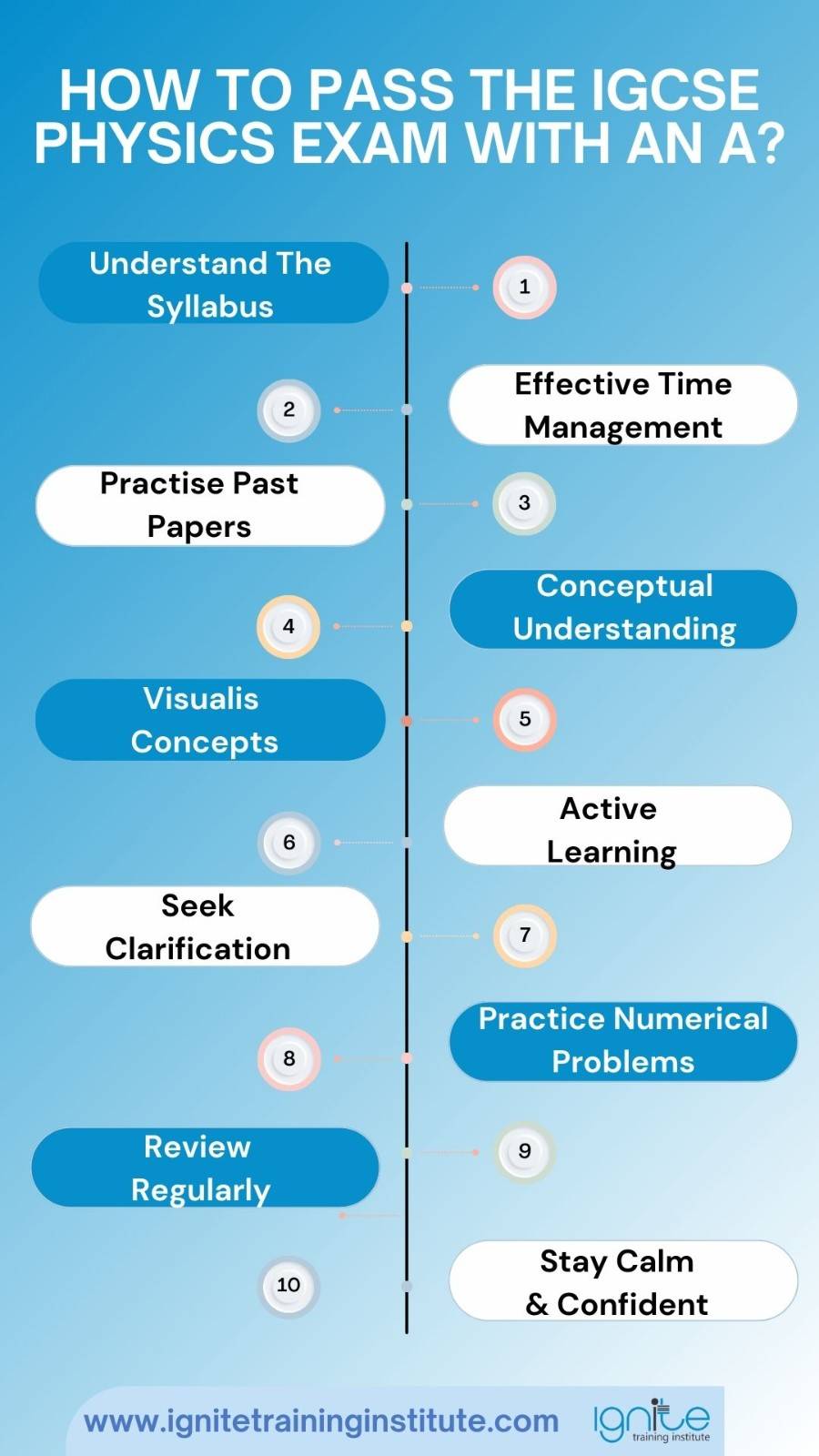
Preparing for the IGCSE Physics exam can be a daunting task, but with the right strategies, you can aim for that coveted A grade. Here are ten key pointers to help you succeed:
- Understand The Syllabus: Familiarize yourself thoroughly with the exam syllabus to know exactly what topics to focus on.
- Effective Time Management: Create a study schedule that allows sufficient time for each topic, ensuring comprehensive coverage before the exam.
- Practice Past Papers: Regularly practice past exam papers to familiarize yourself with the exam format, types of questions, and time constraints.
- Conceptual Understanding: Focus on understanding key concepts rather than rote memorization, as this will enable you to apply your knowledge to various scenarios.
- Visualize Concepts: Utilize diagrams, illustrations, and animations to visualize complex concepts such as waves, circuits, and atomic structures.
- Active Learning: Engage in active learning techniques such as summarizing, teaching others, and solving problems to reinforce understanding.
- Seek Clarification: Don’t hesitate to ask your teacher or peers for clarification on any concepts or topics you find challenging.
- Practice Numerical Problems: Physics involves numerical problems, so practice solving them regularly to build your problem-solving skills.
- Review Regularly: Continuously review and revise previously covered topics to maintain a strong grasp of the material.
- Stay Calm & Confident: On exam day, stay calm, confident, and focused. Trust in your preparation and abilities to tackle the exam with clarity and composure.
Related: 10 Easiest IGCSE Subjects In 2024 For Academic Excellence
Ignite Training Institute – IGCSE Physics Tutors In Dubai
Are you aiming to ace your IGCSE Physics exams? Look no further than Ignite Training Institute, your pathway to academic excellence. Our tailored tutoring support is designed to empower students with the knowledge, skills, and confidence needed to succeed.
At Ignite, we understand the unique challenges students face in mastering IGCSE Physics concepts. That’s why our expert tutors provide personalized attention, addressing individual learning needs and pacing to ensure comprehensive understanding.
Related: AQA VS CIE: A Closer Look Into The Examination Boards
FAQs
1. Is It Easy To Get A In IGCSE Physics?
Achieving an A in IGCSE Physics requires dedicated study and mastery of the subject’s concepts and skills.
2. What Is The Grade For IGCSE Physics?
IGCSE Physics grades range from A* to G, with A* being the highest and G being the lowest.
3. Is Physics Hard In IGCSE?
Physics in IGCSE can be challenging but manageable with proper understanding and preparation.
Conclusion
IGCSE Physics offers students a fascinating journey into the intricacies of the physical world, empowering them with knowledge, skills, and perspectives that extend far beyond the classroom.
Whether delving into the mechanics of motion, unraveling the mysteries of electricity, or exploring the behavior of waves, students gain a profound understanding of the fundamental principles that govern our universe.
Related: Top Universities That Accept IGCSE Certificate In USA & UK