Exploring the IGCSE Biology syllabus is the first step toward understanding one of the most fascinating areas of science at the secondary level. From cell structures to ecosystems, it offers a comprehensive view of life processes and the natural world. With focused study, it can pave the way for advanced scientific learning and future career opportunities.
This blog takes you through every essential detail, the structure of the syllabus, the difference between core and extended levels, assessment methods, and recent updates. Guidance on key topics, preparation strategies, and answers to common questions will also be provided, making this a complete reference for students aiming for top grades. Expert support can make mastering the subject far easier.
In Dubai, Ignite Training Institute delivers specialised biology tutoring designed to clarify complex concepts, strengthen exam skills, and build confidence. With a structured approach, the path to exam success becomes clear and achievable.
What Is IGCSE Biology?
IGCSE Biology is an internationally recognized qualification that introduces students to the fundamental principles of living organisms and the natural world. It is typically taken by students aged 14–16 as part of their secondary education.
The course covers a wide range of topics, including cell biology, genetics, ecology, human physiology, and plant biology, providing a strong foundation for further study in science.
Designed to develop both theoretical knowledge and practical skills, IGCSE Biology encourages learners to understand scientific concepts, analyze data, and apply their learning to real-world situations. Assessment usually includes written examinations and, in some syllabuses, practical experiments.
By studying IGCSE Biology, students gain not only subject expertise but also critical thinking, problem-solving, and research skills that are valuable in higher education and various career paths, from medicine to environmental science.
Related: IGCSE Subjects For Medicine: Ideal Options For Students
Which Exam Boards Offer The IGCSE Biology?
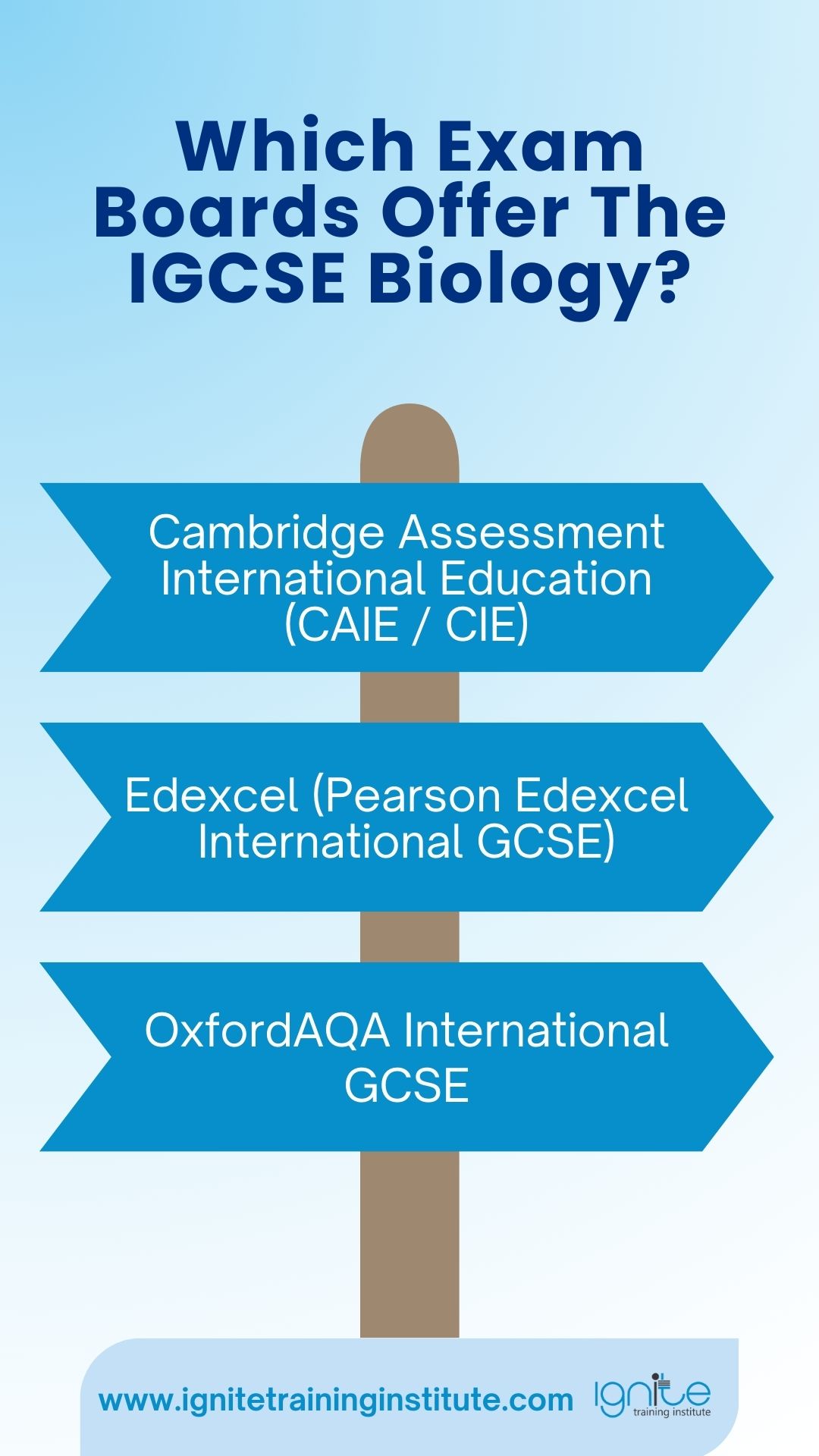
Several internationally recognised exam boards offer the IGCSE Biology syllabus, each with its own structure, assessment methods, and emphasis. The most widely chosen is Cambridge Assessment International Education (CAIE / CIE), which provides the 0610 syllabus and the 0970 Ofqual-regulated version.
Pearson Edexcel International also offers IGCSE Biology with options for separate sciences or combined science awards. Another key provider is OxfordAQA, delivering International GCSE Biology designed to meet global education standards.
While all boards cover core biology concepts such as cell biology, genetics, ecology, and physiology, the content depth, practical requirements, and exam formats can vary. Choosing the right exam board often depends on school curriculum, regional availability, and preferred assessment style.
Related: AQA VS CIE: A Closer Look Into The Examination Boards
Cambridge IGCSE Biology (0610) Syllabus & Assessment Overview
The Cambridge IGCSE Biology (0610) syllabus for 2026–2028 offers a comprehensive and globally respected curriculum designed to foster deep scientific understanding and practical skills in learners. This course is aimed at students aged 14-16 years and provides a solid foundation for further study in biology or related subjects.
Key Objectives
The assessment objectives (AOs) for IGCSE Biology encompass various skills and competencies.
- AO1 focuses on demonstrating knowledge and understanding of scientific phenomena, vocabulary, instruments, and applications, while also emphasizing the ability to apply this knowledge in unfamiliar contexts.
- AO2 emphasizes handling information and problem-solving, requiring candidates to locate, organize, and present information, manipulate data, identify patterns, and solve problems.
- Lastly, AO3 emphasizes experimental skills and investigations, including planning experiments, making observations, interpreting data, and evaluating methods.
Candidates are expected to demonstrate proficiency in these areas through written forms of presentation and practical application, preparing them for the challenges of the IGCSE Biology exams.
Extended & Core Content
The Cambridge IGCSE Biology (0610) syllabus is offered at two levels, Core and Extended, to match different learning needs and help students aim for the grades they are best suited to achieve. Both routes cover the same main topics, but the depth and challenge of the content varies.
The Core curriculum is designed for students aiming for grades C–G. It focuses on the essential principles of biology, ensuring a solid understanding of the basics.
Core candidates take Paper 1 (Multiple Choice), Paper 3 (Theory), and either Paper 5 (Practical Test) or Paper 6 (Alternative to Practical). The content is presented in a straightforward way, simplifying complex concepts so learners can master the fundamentals.
The Extended curriculum is aimed at students who wish to access the full grade range A–G*. It includes all Core topics plus extra content, more advanced applications, and a greater emphasis on higher-order thinking.
Extended candidates take Paper 2 (Multiple Choice), Paper 4 (Theory), and either Paper 5 or Paper 6. The questions demand deeper explanations, more complex calculations, and the ability to apply knowledge in unfamiliar contexts, skills that prepare students well for AS/A Level Biology.
Both approaches cover the same subject areas, so students share a common foundation of learning. The main difference lies in the level of detail and exam expectations.
This flexible structure allows schools to choose the most appropriate route for each learner, with the option to move from Core to Extended during the course if progress and confidence grow.
Core Topics
The syllabus is divided into several core topics, each covering a range of subtopics:
- Characteristics and Classification of Living Organisms – Explores the features of living things and how they are classified into groups.
- Organisation of the Organism – Examines the structure and function of cells, tissues, organs, and organ systems.
- Movement into and out of Cells – Covers diffusion, osmosis, and active transport processes in cells.
- Biological Molecules – Studies the structure and role of carbohydrates, proteins, lipids, and water in living organisms.
- Enzymes – Explains enzyme functions, factors affecting activity, and their role in metabolic reactions.
- Plant Nutrition – Details photosynthesis and mineral requirements for healthy plant growth.
- Human Nutrition – Looks at a balanced diet, digestion, and nutrient absorption in humans.
- Transport in Plants – Describes water and nutrient movement through xylem and phloem.
- Transport in Animals – Explores the circulatory system, blood composition, and transport of substances.
- Diseases and Immunity – Examines causes of disease, immune responses, and prevention methods.
- Gas Exchange in Humans – Explains the structure and function of the respiratory system in humans.
- Respiration – Studies aerobic and anaerobic respiration and their importance for energy release.
- Excretion in Humans – Covers removal of waste products through kidneys, lungs, and skin.
- Coordination and Response – Explores nervous and hormonal control in humans and plants.
- Drugs – Looks at medicinal and recreational drugs and their effects on the body.
- Reproduction – Examines sexual and asexual reproduction in plants and animals.
- Inheritance – Explains genetic material, variation, and inheritance patterns.
- Variation and Selection – Studies genetic diversity, adaptation, and natural selection.
- Organisms and Their Environment – Explores ecosystems, feeding relationships, and environmental factors.
- Human Influences on Ecosystems – Examines pollution, deforestation, and conservation efforts.
- Biotechnology and Genetic Modification – Details the use of technology to modify organisms for human benefit.
Assessment Structure
Paper 1: Multiple Choice (Core)
- Duration: 45 minutes
- Marks: 40 marks (30%)
- Format: 40 four-option multiple-choice questions
- Assessment: Externally assessed
- Description: Paper 1 focuses on multiple-choice questions, exclusively covering core subject content. Candidates have 45 minutes to complete this paper, which constitutes 30% of the total marks for the core assessment.
Paper 2: Multiple Choice (Extended)
- Duration: 45 minutes
- Marks: 40 marks (30%)
- Format: 40 four-option multiple-choice questions
- Assessment: Externally assessed
- Description: Paper 2 follows a similar format to Paper 1 but includes both core and supplemental subject content. Candidates have 45 minutes to answer 40 multiple-choice questions, accounting for 30% of the extended assessment marks.
Paper 3: Theory (Core)
- Extended Assessment:
- Duration: 1 hour 15 minutes
- Marks: 80 marks (50%)
- Format: Short-answer and structured questions
- Assessment: Externally assessed
- Description: Paper 3 consists of theory-based questions, also based solely on core subject content. Candidates are required to answer short-answer and structured questions within a duration of 1 hour 15 minutes. This paper contributes 50% to the overall core assessment marks.
Paper 4: Theory (Extended)
- Duration: 1 hour 15 minutes
- Marks: 80 marks (50%)
- Format: Short-answer and structured questions
- Assessment: Externally assessed
- Description: Paper 4 mirrors the structure of Paper 3 but encompasses both core and supplemental subject content. Candidates tackle short-answer and structured questions within 1 hour 15 minutes. This paper contributes 50% to the extended assessment marks.
Practical Assessment:
Paper 5: Practical Test
- Duration: 1 hour 15 minutes
- Marks: 40 marks (20%)
- Format: Questions related to experimental skills can be found in Section 4.
- Assessment: Externally assessed
- Description: Candidates select either Paper 5 or Paper 6. Paper 5 is a practical test evaluating experimental skills outlined in Section 4 of the curriculum. It lasts for 1 hour 15 minutes and contributes 20% to the total marks.
Paper 6: Alternative To Practical
- Duration: 1 hour
- Marks: 40 marks (20%)
- Format: Questions related to experimental skills can be found in Section 4.
- Assessment: Externally assessed
- Description: Alternatively, candidates may choose Paper 6, which also evaluates experimental skills in Section 4. It is structured similarly to Paper 5 but has a shorter duration of 1 hour and contributes 20% to the total marks.
Skills Development
- Scientific Inquiry: Cultivating the ability to ask questions, make predictions, and design experiments to investigate biological phenomena.
- Critical Thinking: Analyzing data, evaluating evidence, and forming conclusions based on biological concepts and principles.
- Communication: Effectively communicating scientific ideas, findings, and arguments through written reports, presentations, and discussions.
- Practical Laboratory Skills: Acquiring hands-on experience with laboratory techniques, including observation, measurement, data collection, and analysis.
- Problem-Solving: Applying biological knowledge and understanding to solve real-world problems, including those related to environmental sustainability, human health, and biodiversity conservation.
Recent Updates & Revisions
Cambridge has confirmed that the 2026–2028 Biology syllabus (version 1, published September 2023) introduces no significant changes that affect teaching. This means that existing textbooks and resources endorsed for the 2023 syllabus remain fully suitable and aligned with the new cycle.
Additionally, the updated syllabus has been refined for clarity and usability, making it more accessible and easier to interpret for both teachers and students. The changes aim to maintain familiar features while enhancing understanding of learning and assessment expectations.
These revisions reflect Cambridge’s broader approach of continuously reviewing syllabuses to ensure they remain relevant, coherent, and supportive of both effective teaching and student learning, without causing disruption to schools’ existing programmes.
Further Studies & Career Opportunities
The IGCSE Biology course prepares students for advanced studies such as Cambridge International A Levels, the International Baccalaureate (IB), and other equivalent qualifications. It also lays the groundwork for careers in fields such as medicine, biotechnology, environmental science, and research.
Related: IGCSE Chemistry Syllabus: AQA, Edexcel, & CIE Boards Insights
Edexcel IGCSE Biology Syllabus & Assessment Overview
The Edexcel International GCSE (IGCSE) Biology curriculum provides a detailed and comprehensive introduction to the essential principles and concepts of biology.
Aimed at students in the age group of 14-16, this course lays a solid foundation for further studies in biological sciences and related disciplines. The syllabus emphasizes not only theoretical understanding but also the development of practical skills and scientific thinking.
Key Objectives
The key objectives of the Edexcel IGCSE Biology qualification are to:
- Understand and apply fundamental patterns and themes in biology to varied situations.
- Acquire a comprehensive knowledge of biological facts, terms, concepts, and practical techniques.
- Develop analytical and evaluative skills for biological information, emphasizing accurate experimental work and scientific reporting.
- Prepare for advanced biology courses, fostering problem-solving abilities and mathematical application within a broader context.
Core Topics
The syllabus is structured around several key topics, each encompassing a range of subtopics:
- The Nature & Variety Of Living Organisms: Characteristics of living organisms, classification, and diversity.
- Structures And Functions In Living Organisms:
- Cell Structure & Organization: Types of cells, cellular components, and their functions.
- Biological Molecules: Carbohydrates, proteins, lipids, enzymes, and their roles.
- Movement Of Substances Into & Out Of Cells: Diffusion, osmosis, and active transport.
- Animal Physiology:
- Nutrition: Human digestive system, balanced diet, enzymes.
- Respiration: Aerobic and anaerobic respiration, gas exchange system.
- Transport: Circulatory system, blood composition, and function.
- Excretion: Kidney function, urinary system.
- Coordination And Response: Nervous system, hormones, homeostasis.
- Plant Physiology:
- Photosynthesis: Process, factors affecting photosynthesis.
- Transport In Plants: Xylem and phloem functions, transpiration.
- Reproduction & Inheritance:
- Reproduction: Sexual and asexual reproduction in plants and animals.
- Inheritance: Principles of genetics, inheritance patterns, DNA structure and function.
- Ecology & The Environment:
- Ecosystems: Interactions within ecosystems, energy flow, nutrient cycles.
- Human Impact on the Environment: Pollution, conservation, biodiversity.
Assessment Structure
The Pearson Edexcel International GCSE in Biology consists of two externally-assessed papers: Biology Paper 1 and Biology Paper 2. Here’s an overview of each paper:
Biology Paper 1 (Paper code 4BI1/1B & 4SD0/1B)
- Availability: Offered in January and June
- First assessment: June 2019
- Accounts for 61.1% of the total International GCSE
Content Summary:
- Assesses core content, excluding bolded and ‘B’ referenced topics
- Questions encompass a range of topics, including the nature and diversity of living organisms, their structures and functions, reproduction and inheritance, ecology and the environment, as well as the utilization of biological resources.
- Assessment:
- A 2-hour written examination administered and graded by Pearson
- Total marks: 110
- The question formats include multiple-choice, short-answer, calculation, and extended open-response types.
- Calculators are permitted
Biology Paper 2 (Paper code 4BI1/2B)
- Availability: Offered in January and June
- First assessment: June 2019
- Accounts for 38.9% of the total International GCSE
Content Summary:
- Assesses all content, including bolded and ‘B’ referenced topics
- Questions encompass various areas similar to Paper 1
- Bold statements delve deeper into certain sub-topics
- Assessment:
- A 1-hour and 15-minute written exam, administered and graded by Pearson
- Total marks: 70
- The question formats include multiple-choice, short-answer, calculation, and extended open-response questions.
- Calculators are permitted
Skills Development
The course aims to develop several critical skills in students:
- Analytical and critical thinking.
- Practical laboratory skills and safety.
- Data interpretation and analysis.
- Scientific communication, both written and verbal.
Further Studies & Career Opportunities
Edexcel IGCSE Biology provides a strong foundation for advanced studies such as A Levels, International Baccalaureate (IB), and other equivalent qualifications. It prepares students for careers in fields including medicine, biomedical research, environmental science, biotechnology, and various health-related professions.
Related: IGCSE Physics: AQA, CIE, & Edexcel Exam Boards Overview
AQA IGCSE Biology Syllabus & Assessment Overview
The AQA International General Certificate of Secondary Education (IGCSE) in Biology is a comprehensive course designed to give students a thorough understanding of biological principles and the scientific method.
The course covers a broad range of topics, emphasizing the understanding of biological concepts and their application in real-world contexts. Below is an overview of the key components of the AQA IGCSE Biology curriculum.
Course Structure
The AQA IGCSE Biology course is divided into several main topics, each covering specific aspects of biology:
- Cell Biology
- Cell Structure And Function
- Types Of Cells And Their Functions
- Microscopy And Magnification
- Cell Division And Differentiation
- Organization
- Levels Of Organization In Organisms
- The Human Digestive System
- Plant Tissues And Organ Systems
- Enzyme Function And Their Role In The Body
- Infection And Response
- Pathogens And Communicable Diseases
- The Immune System And Its Response To Pathogens
- Vaccination And Antibiotics
- Plant Diseases And Defenses
- Bioenergetics
- Photosynthesis And Factors Affecting It
- Aerobic And Anaerobic Respiration
- Energy Transfer In Ecosystems
- Homeostasis & Response
- The Human Nervous System
- Hormonal Coordination And Control
- Homeostasis In Humans
- Reproductive Hormones And Menstrual Cycle
- Inheritance, Variation & Evolution
- DNA and The Genome
- Inheritance Patterns And Genetic Crosses
- Variation And Natural Selection
- Evolution And The Development Of New Species
- Ecology
- Ecosystems And Their Components
- Food Chains And Food Webs
- Biodiversity And Its Importance
- Human Impact On The Environment
Assessment
The assessment for AQA IGCSE Biology consists of two written examination papers, each contributing 50% to the final grade. The exams test students’ knowledge and understanding of the topics, their ability to apply biological concepts, and their practical skills in interpreting and analyzing scientific data.
Paper 1:
- Assessed Topics: Cell biology, Organisation, Infection and Response, Bioenergetics.
- Assessment Format: Written exam lasting 1 hour and 45 minutes.
- Tier: Available in both Foundation and Higher Tiers.
- Marks: Carries 100 marks, contributing 50% to the GCSE.
- Question Types: Multiple-choice, structured, closed short-answer, and open-response formats.
Paper 2:
- Assessed Topics: Homeostasis and response, Inheritance, variation and evolution, Ecology.
- Assessment Format: Also a written exam lasting 1 hour and 45 minutes.
- Tier: Offered in both Foundation and Higher Tiers.
- Marks: Equally carries 100 marks, accounting for 50% of the GCSE.
- Question Types: Like Paper 1, it includes multiple choice, structured, closed short answer, and open response questions.
Practical Skills
While the IGCSE Biology course emphasizes theoretical knowledge, practical skills are also crucial. Students are encouraged to engage in various laboratory activities to enhance their understanding of biological concepts and processes. Practical work helps develop skills in observation, experimentation, and data analysis, which are essential for scientific inquiry.
Related: How To Study For IGCSE Biology? 10 Must-Know Tips
Ignite Training Institute: IGCSE Biology Tutors In Dubai
At Ignite Training Institute in Dubai, our team of experienced tutors specializes in IGCSE Biology, offering tailored support to students preparing for exams under the Cambridge, Edexcel, and AQA boards.
With a focus on personalized guidance, comprehensive resources, and proven teaching methodologies, our tutors are dedicated to helping students master the intricacies of biology and excel in their exams.
Whether it’s clarifying complex concepts, practicing practical skills, or refining exam strategies, Ignite Training Institute provides the expertise and support needed for students to achieve their academic goals in IGCSE Biology.
Related: Edexcel IGCSE Biology Syllabus – A Student’s Critical Guide
FAQs
1. Is IGCSE Biology Hard?
IGCSE Biology difficulty varies depending on individual strengths and study habits, but with proper preparation, it is manageable for many students.
2. How Are Students Assessed In IGCSE Biology?
Students are assessed through a combination of theory papers, multiple-choice questions, and a practical test or alternative to practical. Assessment evaluates knowledge, understanding, and experimental skills.
3. Why Study IGCSE Biology?
Studying IGCSE Biology provides a foundational understanding of the living world and opens doors to various scientific fields and careers.
4. Can I Drop Biology In IGCSE?
Yes, it’s possible to drop Biology in IGCSE, but it may affect future academic and career opportunities requiring a science background.
5. How To Get A 9 In IGCSE Biology?
Achieving a 9 requires strong conceptual understanding, consistent practice with past papers, and mastery of scientific terminology. Time management in exams and accuracy in application-based questions are also essential.
6. What Are The Requirements For IGCSE Biology?
There are no formal prerequisites for taking IGCSE Biology. However, a basic understanding of science and an interest in biological concepts are recommended for success.
7. What Is Removed From The IGCSE Biology Syllabus?
The 2026–2028 syllabus includes no significant content removals that affect teaching. All previously endorsed learning materials remain relevant and suitable for exam preparation.
8. What Is The Difference Between Biology 0610 And 0970?
Biology 0610 is the international version of the syllabus, while Biology 0970 is the UK GCSE-equivalent regulated by Ofqual. Both have similar content, but 0970 includes some UK-specific assessment standards.
9. How Many Papers Are In IGCSE Biology?
Students take three papers: a multiple-choice paper, a theory paper, and either a practical test or an alternative to practical paper. The combination depends on whether the student is entered for Core or Extended.
Conclusion

IGCSE Biology is essential for understanding the natural world and lays the foundation for careers in various scientific fields. Its significance lies in its practical applications, from medicine to environmental conservation, and in fostering critical thinking and problem-solving skills vital for navigating today’s challenges.
Related: Best IGCSE Tutors In Dubai To Achieve Grade Excellence