The International Baccalaureate Middle Years Programme (IB MYP) is an internationally recognized framework that prepares students aged 11 to 16 for academic success and personal growth. It offers a well-rounded education that emphasizes inquiry-based learning, global awareness, and critical thinking across eight subject areas.
With a focus on developing strong Approaches to Learning (ATL) skills, the MYP ensures that students are equipped to tackle challenges both in and outside of the classroom.
At Ignite Training Institute, we specialize in providing expert tutoring for students enrolled in the MYP, helping them navigate the program’s rigorous demands while fostering a deep understanding of the subject matter. With our tailored approach, we ensure students excel academically and develop the essential skills they need to thrive in a globalized world.
What Is The IB MYP Programme?
The International Baccalaureate Middle Years Programme (IB MYP) is a globally recognized educational framework for students aged 11 to 16. It helps learners connect classroom knowledge with real-world contexts, emphasizing critical thinking, creativity, and practical understanding.
The MYP equips students with the skills and mindset needed for future academic pathways, such as the IB Diploma Programme (DP) or the IB Career-related Programme (CP), as well as for broader career opportunities.
The curriculum is structured around eight subject groups, providing a broad and balanced education. Each subject group receives a minimum of 50 teaching hours per year, allowing students to explore multiple disciplines while developing essential academic and life skills.
The programme is designed to be flexible, usually spanning five years, though some schools offer shorter versions lasting two to four years. To support age-appropriate learning, the MYP is divided into Lower MYP and Upper MYP stages.
Lower MYP
The Lower MYP typically covers Grades 6 to 8 (ages 11–14). At this stage, students study all subject groups, with flexibility to choose one language in Language Acquisition. Alongside assessed subjects, they engage in unassessed enrichment activities such as music, dance, and drama, supporting holistic development. The focus is on building foundational knowledge, inquiry skills, and critical thinking to prepare for the more advanced Upper MYP.
Upper MYP
The Upper MYP usually includes Grades 9 and 10 (ages 14–16). Students are given greater flexibility in subject choices based on their interests and future goals. They also prepare for the optional MYP eAssessment, which includes:
- On-screen examinations
- ePortfolios for subjects such as arts, design, and sciences
- Interdisciplinary assessment
- Personal Project, showcasing independent learning and skills application
The MYP eAssessment offers formal IB recognition through MYP course results and the IB MYP Certificate, validating students’ achievements internationally.
Throughout both stages, students are encouraged to engage in community service and real-world projects, reinforcing responsibility, leadership, and practical problem-solving skills.
Related: List Of Top 10 Benefits Of The IB Diploma Programme
What Are The Objectives Of The IB MYP Programme?
The IB Middle Years Programme (MYP) aims to develop inquisitive, confident, and lifelong learners by connecting classroom knowledge to real-world contexts. It emphasizes critical thinking, conceptual understanding, and interdisciplinary learning, while fostering key skills through Approaches to Learning (ATL), including communication, collaboration, research, thinking, and self-management.
Students are encouraged to explore global issues, understand diverse perspectives, and engage in community service, helping them grow as responsible and internationally minded individuals.
The programme also supports holistic development, nurturing intellectual, personal, emotional, and social growth. By building strong academic foundations, ATL skills, and essential life skills, the MYP prepares students to transition smoothly to the IB Diploma Programme (DP), the IB Career-related Programme (CP), or other advanced educational pathways, equipping them for future academic and career success.
Related: A-Levels VS IBDP: 5 Differences To Make The Right Decision
IB Middle Year Programme Subjects (IB MYP Program Components)
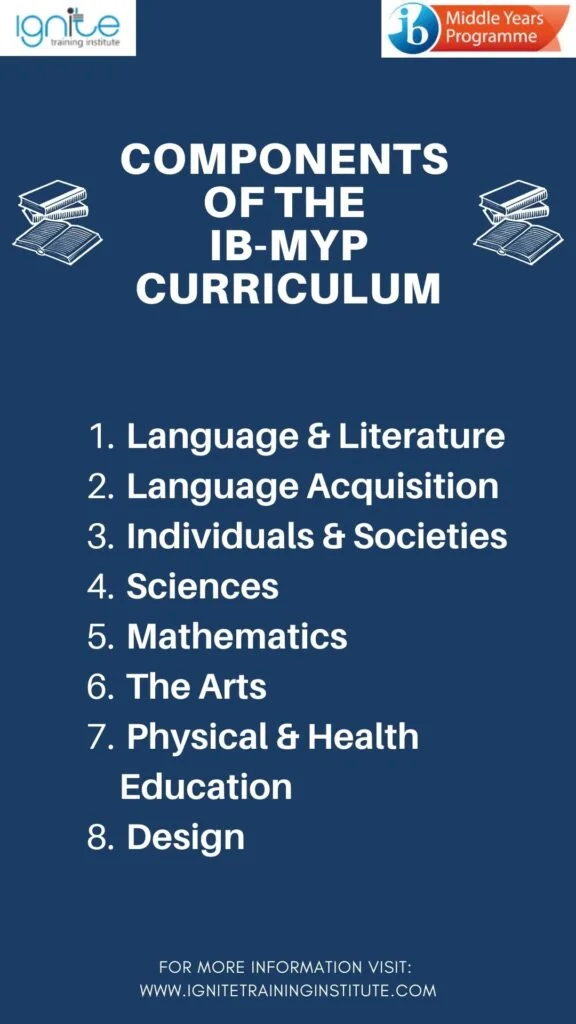
The IB Middle Years Programme (MYP) includes a comprehensive curriculum designed to provide students with a broad, balanced education. The program covers eight subject groups that ensure students gain a well-rounded understanding of the world around them. These subjects are:
1. Language & Literature
Language and Literature in the MYP develops listening, speaking, reading, writing, viewing, and presenting skills. Inquiry is central, allowing students to investigate, reflect, and take action both independently and collaboratively.
The subject helps students build critical thinking, intercultural understanding, and ethical reasoning by engaging with a wide range of literary and non-literary texts.
Courses often include multiple languages, supporting mother tongues while exploring cultural identity and personal development, enabling students to interpret meaning, analyze context, and express ideas effectively.
2. Language Acquisition
Language Acquisition in the MYP helps students develop language skills while exploring culture, identity, and different perspectives. It is a compulsory subject every year, with learning offered in at least two languages.
Organized into six flexible phases, students progress at their own pace, building reading, writing, speaking, and viewing skills.
Assessment through MYP ePortfolios measures fluency at emergent, capable, or proficient levels, ensuring personalized and meaningful language learning.
3. Individuals & Societies
Individuals and Societies in the MYP combine humanities and social sciences to help students explore the world around them. Students collect and analyze data, test hypotheses, and interpret complex information from real-world examples.
The subject encourages understanding of historical, social, political, economic, cultural, and environmental factors, fostering critical thinking and global awareness. Courses can be structured as discrete, modular, or integrated, allowing students to study multiple disciplines while developing inquiry, research, and analytical skills.
This approach ensures students gain the knowledge and understanding needed to engage meaningfully with local and global issues.
4. Sciences
Sciences in the MYP encourages students to explore the natural world through research, observation, and experimentation, both independently and collaboratively. Students investigate real-world applications of science while considering ethical, cultural, economic, political, and environmental implications.
Courses typically include biology, chemistry, and physics, but may also cover environmental science, life sciences, physical sciences, sports science, health science, and earth science.
Interdisciplinary units allow students to combine knowledge from multiple scientific fields, fostering critical thinking, ethical reasoning, and a sense of responsibility as informed members of local and global communities.
5. Mathematics
Mathematics in the MYP promotes inquiry and practical application, helping students develop problem-solving skills that extend beyond the classroom. The curriculum covers number, algebra, geometry, trigonometry, statistics, and probability, allowing students to model real-world situations and find solutions to both familiar and unfamiliar problems.
MYP mathematics equips students with the knowledge and skills needed for further study in mathematics, sciences, engineering, and technology, as well as everyday life.
Courses are offered at standard and extended levels, with extended mathematics providing additional depth for students preparing for higher-level studies in the IB Diploma Programme.
6. Arts
Arts in the MYP allows students to create, perform, and present work that expresses ideas, experiences, and emotions, helping them develop and master artistic skills. Students engage as both artists and learners, exploring dance, music, theatre, media arts, and visual arts.
Participation in the arts stimulates imagination, enhances creative and analytical skills, and fosters cultural awareness and empathy.
Courses can be structured as discrete disciplines, integrated programs, or modular rotations, providing students with diverse opportunities to develop personal expression, aesthetic understanding, and a deeper appreciation of art in real-world contexts.
7. Physical & Health Education
Physical and Health Education in the MYP helps students understand the value of being active and develop motivation for healthy lifestyle choices. The subject combines learning through and about physical activity, covering fitness, nutrition, biomechanics, and sport skills.
Students participate in team sports, individual activities, aesthetic movement, and international or adventure sports, building physical competence, collaboration, and communication skills.
By fostering well-being, social responsibility, and positive relationships, MYP physical and health education supports holistic development and lifelong healthy habits.
8. Design
Design in the MYP encourages students to apply creative and practical thinking to solve real-world problems. The subject emphasizes the design process over final products, guiding students through inquiry, analysis, development, creation, testing, and evaluation of models, prototypes, or systems.
Courses may focus on digital design, product design, or a combination of both, helping students develop problem-solving skills, innovation, and responsible decision-making in historical and contemporary contexts.
Across all subjects, IB-MYP develops Approaches to Learning (ATL) skills like communication, research, collaboration, and critical thinking. Students apply learning through interdisciplinary units and the community and personal projects.
These experiences build academic, personal, and social skills, preparing them for the International Baccalaureate Diploma Programme (DP), Career-related Programme (CP), and future success.
Related: IB Program Pros & Cons: 10 Takeaways You Must Know
How Is The IB MYP Programme Structured?
The IB Middle Years Programme (MYP) is structured as a five-year framework for students aged 11 to 16, running from MYP 1 to MYP 5. It is designed to provide balanced learning progression while allowing schools flexibility within International Baccalaureate standards.
The programme is organised around eight subject groups: Language and Literature, Language Acquisition, Individuals and Societies, Sciences, Mathematics, Arts, Design, and Physical and Health Education. Students study all subject groups each year to ensure broad academic exposure.
Learning is structured through concept-based teaching and global contexts, helping students connect subject knowledge to real-world and global issues. Approaches to Learning (ATL) skills, such as communication, research, thinking, collaboration, and self-management, are embedded across all subjects.
Assessment follows a criterion-related model, measuring achievement against defined objectives rather than peer comparison. In MYP 5, students may take an optional eAssessment for external recognition.
The structure also includes project work, with the Community Project in the middle years and the Personal Project in the final year, enabling students to apply learning independently and develop real-life skills.
Related: What Is An Extended Essay For IB? A Latest Guide
Assessment & Exam Structure Of IB MYP
The International Baccalaureate Middle Years Programme (IB MYP) focuses on a rigorous assessment structure that evaluates students across various criteria, blending internal and external assessments. Here’s a breakdown of its main components:
1. Assessment Criteria
Each subject in the MYP uses four key assessment criteria:
- Criterion A (Knowing and Understanding): Evaluates a student’s grasp of fundamental knowledge in the subject.
- Criterion B (Inquiring and Designing): Assesses the student’s ability to formulate questions, design investigations, and plan experiments.
- Criterion C (Processing and Evaluating): Focuses on data collection, analysis, and the interpretation of results.
- Criterion D (Reflecting on the Impact of Science): Encourages students to consider broader implications and ethical dimensions of scientific developments.
2. eAssessment For MYP Certificate
At the end of the MYP (typically in Year 5), students can opt for eAssessments to earn the MYP Certificate.
These include on-screen exams in core areas like Language and Literature, Sciences, Mathematics, Individuals and Societies, and Interdisciplinary Learning. Students also submit ePortfolios in other subjects, such as Arts, Physical and Health Education, or Design.
The Personal Project, a year-long independent research project, is also mandatory for certificate qualification.
3. Grading System
Each subject assessment is graded from 1 to 7. To earn the certificate, students must complete eight assessments, achieving a minimum combined score of 28 points, with at least a score of 3 in each assessment.
This cumulative approach allows students to demonstrate understanding across a range of academic and practical skills.
4. Interdisciplinary Learning
MYP emphasizes interdisciplinary thinking, linking subject knowledge to real-world applications and global contexts.
For example, on-screen assessments require students to apply interdisciplinary knowledge, especially in the sciences, which may integrate biology, chemistry, and physics to address comprehensive questions.
This multifaceted assessment system helps foster critical thinking, self-management, and collaborative skills, preparing students for the next stages of IB education or other academic pursuits.
Related: How To Study For IB Exams? 10 Preparation Tips That Works
IB MYP Grade Boundaries: How Scores Are Calculated?
IB MYP grade boundaries explain how student performance is converted into final grades. The assessment system is criterion based, meaning students are evaluated against fixed standards rather than compared with peers.
Each subject in the IB Middle Years Programme is assessed using four criteria, with each criterion scored from 0 to 8. This results in a maximum total score of 32 marks per subject, based on coursework, class assessments, projects, and examinations.
Once the total score out of 32 is calculated, it is converted into a final IB MYP grade on a scale of 1 to 7 using grade boundaries set by the International Baccalaureate. A commonly used grade boundary scale is:
- 28–32 marks: Grade 7
- 24–27 marks: Grade 6
- 19–23 marks: Grade 5
- 15–18 marks: Grade 4
- 10–14 marks: Grade 3
- 6–9 marks: Grade 2
- 1–5 marks: Grade 1
These grade boundaries may vary slightly each year, particularly for schools using MYP eAssessment, as the IB reviews boundaries to maintain global consistency and fairness.
For schools that do not use eAssessment, teachers apply IB grade descriptors and internal boundary guidelines that follow the same scoring principles. This ensures that results remain aligned with IB standards worldwide.
Related: 10 Tips On How To Get Good Grades In IB Curriculum Exams
IB MYP Certificate: Is It Worth It?
The IB MYP Certificate is awarded to students who complete the final year of the IB Middle Years Programme and meet the required assessment criteria. It reflects a student’s academic progress and skills development during the middle school years.
The certificate is especially valuable for students planning to move on to the IB Diploma Programme, as it builds strong foundations in inquiry based learning, research, time management, and independent thinking. It is recognised across IB World Schools as a marker of readiness for more rigorous academic study.
While the IB MYP Certificate is not a standalone school leaving qualification and has limited direct use for university admissions, it highlights important skills gained through criterion based assessment and the Personal Project.
Overall, the IB MYP Certificate is worth it for students seeking strong academic preparation, global learning exposure, and a smooth transition into advanced IB programmes.
Related: IB Bilingual Diploma: What It Is & Should You Pursue It?
Benefits Of IB MYP Curriculum Learning
The IB Middle Years Programme (MYP) offers more than academic knowledge. It is designed to develop well-rounded, confident, and globally minded students who are prepared for both higher education and real-world challenges. Here are the key benefits of the IB MYP curriculum:
1. Real-World Application
The MYP encourages students to connect classroom learning to real-life situations. By exploring concepts across subjects and engaging with global contexts, students develop a practical understanding of knowledge and a curiosity that extends beyond school.
2. Personalized Support & Growth
Every student has unique strengths and learning preferences. The MYP tailors guidance to individual needs, helping students build confidence, recognize their talents, and pursue their passions while focusing on personal growth rather than comparisons with peers.
3. Essential Lifelong Skills
Through the Approaches to Learning (ATL) framework, students cultivate critical thinking, communication, collaboration, self-management, and research skills. These competencies are vital for success in higher education, careers, and life beyond the classroom.
4. Ethical Awareness & Global Citizenship
MYP learning emphasizes values such as responsibility, respect, and intercultural understanding. Students develop ethical reasoning, problem-solving abilities, and the capacity to contribute positively to diverse communities around the world.
5. Service & Community Engagement
Service learning connects classroom knowledge with meaningful community action. Students design projects aligned with their interests and skills, fostering a sense of responsibility and a deeper awareness of their role in improving the world around them.
6. International Recognition
The IB MYP is recognized and respected globally. Its rigorous, student-centered approach prepares learners for advanced studies, and universities worldwide acknowledge MYP graduates as innovative, analytical, and capable young adults.
Related: 10 IB Learner Profile Attributes Shaping Your Future
How IB MYP Prepares Students For IB Diploma Programme?
The IB Middle Years Programme (MYP) lays a strong foundation for students aiming to pursue the IB Diploma Programme (DP) by developing both academic knowledge and essential skills.
Through its broad and balanced curriculum, students gain exposure to multiple subjects, while concept-based learning and global contexts encourage them to make meaningful connections between their studies and the real world.
Additionally, the MYP’s project-based learning, notably the Personal Project in the final year-enables students to work independently, plan effectively, and demonstrate problem-solving skills.
Optional MYP eAssessments provide experience with external evaluations and formal recognition, familiarizing students with IB-style assessments. Together, these experiences prepare learners to transition smoothly into the IB DP, ready to tackle higher-level coursework and develop as self-directed, internationally minded scholars.
Related: IB Subject Choices: A 2025 Guide For Subject Combinations
Ignite Training Institute: Best IB MYP Tutors In Dubai, UAE
Ignite Training Institute stands out as the #1 IB MYP Tutors in Dubai, UAE, dedicated to empowering students to excel in the International Baccalaureate Middle Years Programme. Our team of highly qualified and experienced tutors specializes in the MYP curriculum, providing personalized instruction that caters to each student’s unique learning style and academic needs.
At Ignite, we emphasize a holistic approach to education, fostering critical thinking, intercultural understanding, and real-world application of knowledge, ensuring that our students not only achieve outstanding academic results but also develop essential life skills.
What sets Ignite Training Institute apart is our unwavering commitment to student success. We offer tailored tutoring sessions, comprehensive study materials, and continuous progress assessments to track and enhance each student’s performance. Our proven track record of helping students achieve top grades and secure placements in prestigious IB Diploma Programs speaks volumes about our effectiveness.
Related: What Is An IB World School? All You Need To Know
FAQs
1. What Is IB MYP?
The IB Middle Years Programme (MYP) is an international education framework for students aged 11 to 16 that focuses on conceptual learning, real world application, and global awareness.
2. Who Is The IB MYP Designed For?
IB MYP is designed for students in Grades 6 to 10 who want a broad, balanced education that builds academic knowledge alongside personal and social skills.
3. How Is Students’ Performance Assessed In IB MYP?
Student performance in IB MYP is assessed through criteria based evaluations, including projects, classwork, exams, and a mandatory personal project in the final year.
4. Is IB MYP Recognized Internationally?
Yes, IB MYP is recognized by schools and education systems worldwide and supports smooth progression to IB Diploma Programme, IGCSE, and other national curricula.
5. What Skills Do Students Develop Through IB MYP?
Students develop critical thinking, communication, research, collaboration, self-management, and problem solving skills that prepare them for higher education and real-life challenges.
6. How Is The IB MYP Curriculum Different From Other Curricula?
The IB MYP curriculum operates on eight subject groups, which are designed to promote intellectual and personal development. The focus is on interdisciplinary learning, so students have a unique opportunity to explore connections between different subjects.
7. What Grade Is MYP 1?
MYP 1 typically corresponds to Grade 6, for students around 11–12 years old.
8. What Grade Is MYP 5?
MYP 5 usually aligns with Grade 10, for students around 15–16 years old.
9. What Is MYP 4?
MYP 4 is equivalent to Grade 9, aimed at students around 14–15 years old.
10. What Age Group Is IB MYP For?
IB MYP is designed for students aged 11 to 16.
Conclusion

So there you have it! Everything you need to know about the IB-MYP. MYP is a great way to get ahead in your studies and prepare for a career in a wide range of fields. If you’re looking for a rigorous, internationally recognized program, MYP is the way to go.
Now that you know everything there is to know about the IB MYP curriculum, what are you waiting for? Get started on your journey to academic success today! And there’s no need to go it alone – Ignite Training Institute is here to help you every step of the way. With their experienced and certified MYP teachers, they offer comprehensive courses that cover all aspects of the curriculum. Contact them today to learn more!
Related: IB Diploma Programme (IBDP) Curriculum: A Complete Guide