Achieving success in GCSE Maths requires strategic preparation, effective study techniques, and consistent practice. Whether aiming to boost your grades or secure top marks, understanding the key concepts and honing your problem-solving skills is essential.
At Ignite Training Institute, we recognize students’ challenges and offer the best GCSE Maths tutors in Dubai to guide you every step of the way. Our expert tutors provide personalized support, helping you build confidence and excel in your maths exams.
How To Do Well In GCSE Maths: 10 Effective Tips
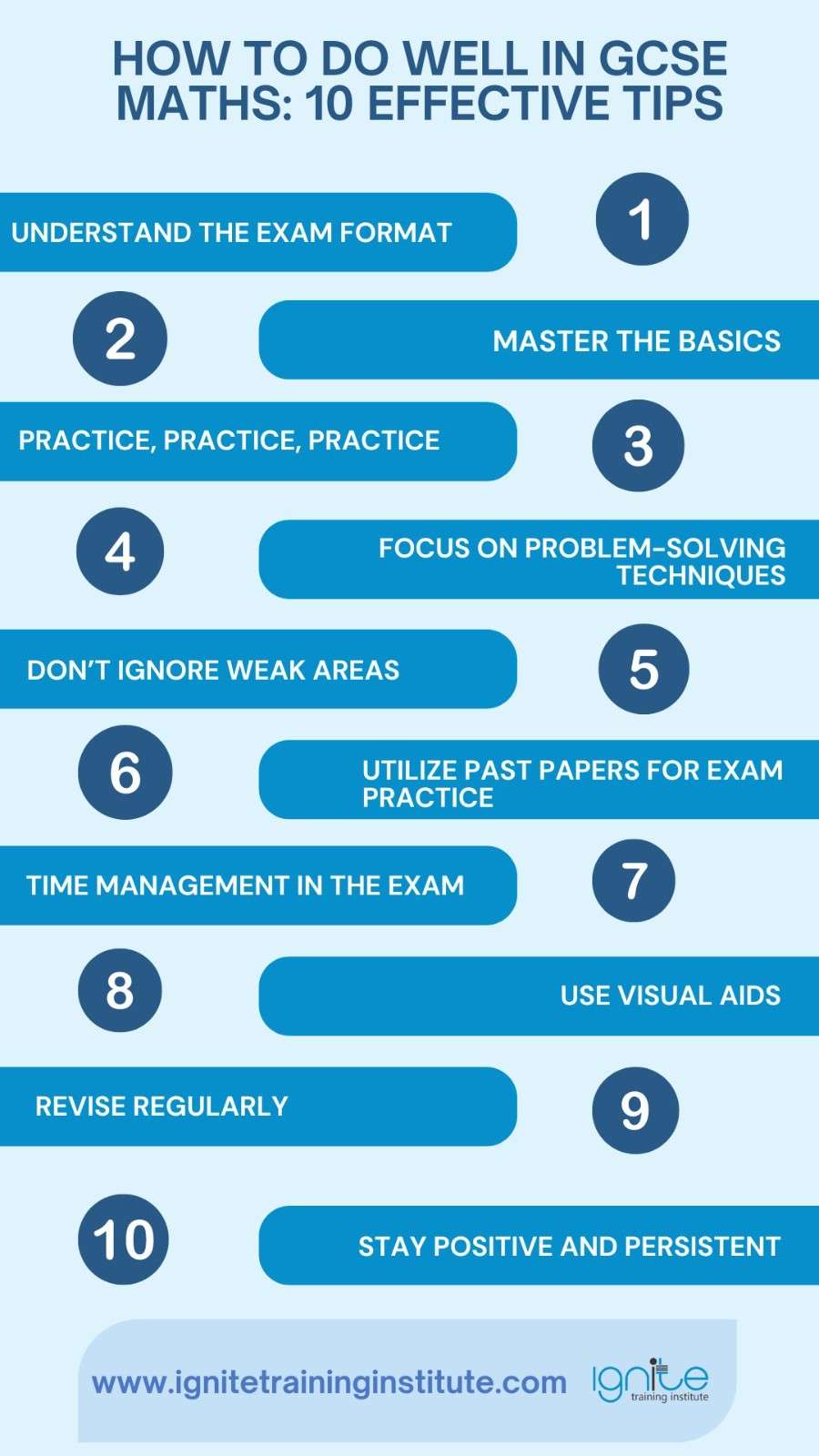
Preparing for GCSE Maths can be challenging, but you can achieve excellent results with the right approach. By mastering the basics, practicing regularly, and focusing on your problem areas, you’ll build a strong foundation.
Success in GCSE Maths isn’t just about natural talent; it’s about strategic preparation and disciplined study habits. Here are ten practical tips to help you excel in your GCSE Maths exams.
1. Understand The Exam Format
Start by familiarizing yourself with the exam structure. Know the types of questions that will appear, the marks allocated for each, and the time limits. This awareness helps you manage time effectively during the exam, allowing you to allocate enough time to each section without rushing or leaving any questions unanswered.
How To Apply It:
Get hold of the latest exam syllabus and practice papers. Work through these papers under timed conditions to get a real feel for the exam. Make note of recurring question formats and topics that are consistently covered.
2. Master The Basics
Maths is a cumulative subject, meaning each topic builds upon the previous one. Ensuring you have a strong understanding of basic concepts, such as algebra, fractions, and geometry, is crucial. Without a firm grasp of these fundamentals, more complex topics will become increasingly difficult.
How To Apply It:
Dedicate time to revising foundational topics regularly. Use resources like Khan Academy or BBC Bitesize to revisit these concepts, ensuring you can confidently tackle basic problems before moving on to more advanced ones.
3. Practice, Practice, Practice
Mathematics is a subject where practice truly makes perfect. The more problems you solve, the more familiar you become with different question types, and the quicker you become at recognizing the best methods to solve them.
How To Apply It:
Allocate specific time each day to work on practice problems. Use past papers, online quizzes, and textbooks. Try to simulate exam conditions as much as possible to build your confidence and speed.
4. Focus On Problem-Solving Techniques
Understanding how to approach a problem is often more important than the solution itself. Learn different strategies for tackling difficult questions, such as breaking problems down into smaller steps or using logical reasoning to eliminate incorrect answers.
How To Apply It:
Study different problem-solving methods and apply them to a variety of questions. Books like “How to Solve It” by George Pólya offer valuable strategies that can be applied to GCSE Maths. Over time, you’ll develop a toolbox of techniques you can rely on during the exam.
5. Don’t Ignore Weak Areas
It’s easy to focus on topics you find interesting or excel in, but it’s the weaker areas that need the most attention. Ignoring these areas could result in lower overall marks.
How To Apply It:
Identify topics that you struggle with and allocate extra study time to them. Use resources like online tutorials, and study groups, or even consider a tutor to help you overcome these challenges. Regularly review these areas until you feel more confident.
6. Utilize Past Papers For Exam Practice
Past papers are one of the most effective tools for exam preparation. They give you a clear idea of the types of questions you can expect, the format of the exam, and the level of difficulty. By working through past papers, you can identify patterns in question types, understand how marks are allocated, and get accustomed to the timing of the exam.
The AQA provides a comprehensive collection of assessment resources for the GCSE Mathematics (8300) specification. It includes past papers, mark schemes, examiner reports, and practice questions to aid both teaching and revision.
These resources are categorized by exam series, component, and tier, helping students and educators efficiently access the materials they need for effective exam preparation.
How To Apply It:
Collect as many past papers as you can, and set aside regular time to complete them under exam conditions. After finishing, thoroughly review your answers, focusing on areas where you lost marks. Make note of recurring question themes and ensure you can tackle similar questions confidently in the actual exam.
7. Time Management In The Exam
One of the biggest challenges in GCSE Maths is managing your time effectively. It’s easy to get stuck on a difficult question and lose valuable time. Learning to move on and come back to it later is a vital skill.
How To Apply It:
During practice exams, focus on pacing. Learn to assess how much time to spend on each question quickly.If you’re feeling stuck, move on to something else and come back to it later if you have time. Practice this technique until it becomes second nature.
8. Use Visual Aids
Maths isn’t just about numbers; visual aids like graphs, charts, and diagrams can be incredibly helpful in understanding and solving problems. These tools can make complex data easier to interpret and can often reveal patterns that aren’t immediately obvious.
How To Apply It:
Whenever possible, draw diagrams or graphs to help visualize the problem. Use colors, labels, and other tools to make these visual aids as clear and informative as possible. Practice drawing these during your revision sessions.
9. Revise Regularly
Cramming the night before an exam is usually not effective. Regular revision ensures that information stays fresh in your mind and helps you retain concepts long-term. This method also reduces stress and makes the entire revision process more manageable.
How To Apply It:
Create a revision schedule that breaks down topics into manageable chunks. Review each topic regularly, increasing the frequency as the exam date approaches. Make use of flashcards, mind maps, and summary sheets to aid memory retention.
10. Stay Positive And Persistent
Finally, a positive mindset can have a huge impact on your performance. Believing in your ability to succeed, coupled with persistent effort, will help you overcome challenges and improve your confidence in Maths.
How To Apply It:
Practice positive self-talk and visualization techniques.Remember your past successes and how far you’ve come. Surround yourself with supportive people who encourage your efforts, and remember that persistence is key to mastering Maths.
Related: IGCSE VS GCSE: Key Differences & Which Offers More?
How To Revise Maths GCSE Effectively?
Revising for GCSE Maths effectively requires a strategic approach that balances understanding core concepts, consistent practice, and time management. Here’s how you can maximize your revision efforts:
1. Understand The Syllabus
- Know The Topics: Start by familiarizing yourself with the GCSE Maths syllabus. Break it down into manageable sections and identify the key topics that require more focus. Knowing what to study is half the battle.
- Use A Checklist: Create a checklist of all the topics covered in the syllabus and tick them off as you review each one. This not only helps you stay organized but also ensures that you don’t miss any important areas.
2. Create A Revision Schedule
- Plan Your Time: Allocate specific time slots for each topic, making sure to revisit challenging areas regularly. A well-structured revision timetable helps you cover all topics and keeps you on track.
- Balance Study Sessions: Alternate between topics and include short breaks to keep your mind fresh. This helps maintain focus and prevents burnout.
3. Practice Regularly
- Solve Past Papers: Practicing past exam papers under timed conditions is one of the most effective ways to prepare. It familiarizes you with the exam format and helps you manage time during the actual exam.
- Work On Weak Areas: Identify the types of questions you find challenging and focus on improving your skills in those areas. Regular practice will help build confidence.
4. Use Different Resources
- Leverage Online Tools: Use online resources such as tutorial videos, interactive quizzes, and revision apps to reinforce your learning. These tools can offer new perspectives and explanations that make complex topics easier to understand.
- Study Guides And Textbooks: Don’t forget traditional resources like textbooks and revision guides. They often provide step-by-step solutions and clear explanations of key concepts.
5. Focus On Understanding, Not Memorizing
- Grasp The Concepts: Ensure you understand the underlying principles behind mathematical problems rather than just memorizing formulas. This deep understanding will help you apply concepts to different types of questions.
- Ask For Help: If you’re struggling with a particular topic, don’t hesitate to ask your teacher or a tutor for help. Sometimes, a different explanation can make things click.
6. Work On Exam Techniques
- Manage Exam Time: Practice completing questions within the allocated time to improve your speed and accuracy. Time management is crucial in ensuring you can complete the exam without rushing.
- Read Questions Carefully: In the exam, read each question carefully to ensure you understand what is being asked before attempting to solve it. Misreading questions is a common mistake that can cost you marks.
7. Stay Positive And Healthy
- Maintain A Positive Attitude: Stay confident and remind yourself that with the right preparation, you can succeed. Positive thinking can significantly impact your performance.
- Look After Your Health: Ensure you get enough sleep, eat well, and take regular breaks during revision.A healthy body helps maintain a sharp mind, which is crucial for effective studying.
8. Review And Reflect
- Regularly Review Your Progress: Periodically review the topics you’ve studied to reinforce your understanding. This helps retain information and ensures that you’re well-prepared across all areas.
- Reflect On Mistakes: Learn from the mistakes you make during practice sessions. Understanding where you went wrong and how to correct it will prevent similar errors in the actual exam.
Related: Cambridge IGCSE: Comprehensive Guide For Parents & Students
How To Ace Your Maths GCSE Exam
To truly stand out and maximize your potential in the Maths GCSE exam, here are some unique and advanced tips that go beyond the usual advice:
1. Decode The Marking Scheme
- Understand How Marks Are Awarded: Go beyond just solving problems—study the marking scheme used in past papers. Pay attention to how marks are allocated for each step in multi-part questions. This will help you understand where to focus your efforts to gain maximum points, even if your final answer is incorrect.
- Strategize Your Approach: Use this knowledge to prioritize your steps during the exam. For example, ensure that you always write down your method, as method marks can be crucial when you’re unsure of the final answer.
2. Reverse Engineer Problems
- Work Backwards From The Solution: Take a complex problem and start from the solution, working backwards to understand how it was derived. This technique helps you see the problem from a different angle and understand the logical flow of how different mathematical principles connect.
- Spot Patterns And Shortcuts: By reverse engineering, you can often spot patterns or shortcuts that aren’t immediately obvious, giving you an edge in problem-solving under timed conditions.
3. Integrate Multi-Sensory Learning
- Engage Multiple Senses: Combine visual, auditory, and kinesthetic learning to deepen your understanding. For instance, draw diagrams or graphs to visualize problems, use apps that convert text to speech to listen to explanations, and physically write out formulas and problems by hand to reinforce memory.
- Teach What You Learn: Try explaining difficult concepts to a peer or even to yourself. Teaching forces you to articulate your understanding clearly and can highlight any gaps in your knowledge.
4. Focus On High-Yield Topics
- Identify High-Frequency Topics: Analyze past papers to identify topics that consistently appear in the exam. Focus your revision on these high-yield areas where you’re likely to score the most marks.
- Master Key Problems: Work on perfecting your approach to the types of questions that often carry the most weight. This ensures that you’re maximizing your efficiency during the exam.
5. Simulate Exam Day Conditions
- Replicate the Exam Environment: Beyond just timed practice, simulate the entire exam experience. Sit in a quiet room, use only the materials allowed in the exam, and even replicate the timing and break schedule. This will make the actual exam day feel more familiar and reduce anxiety.
- Stress Management Practice: Incorporate breathing exercises or mindfulness techniques before and during your practice exams. Learning to manage stress can keep your mind sharp and focused when it counts.
6. Apply The Feynman Technique
- Simplify Complex Concepts: The Feynman Technique involves explaining complex concepts in the simplest terms possible, as if teaching a child. This method forces you to break down ideas into understandable pieces, ensuring you fully grasp the topic.
- Identify Weak Spots: If you struggle to simplify a concept, it’s a sign that you need to review it more thoroughly. This technique can be a powerful tool for pinpointing areas that need more attention.
7. Utilize Active Recall And Spaced Repetition
- Active Recall For Retention: Regularly test yourself on key formulas, concepts, and problem-solving methods without looking at your notes. This active recall strengthens memory and understanding far better than a passive review.
- Spaced Repetition For Mastery: Use a spaced repetition system (SRS) to review information at increasing intervals. This method is scientifically proven to improve long-term retention and is particularly effective for memorizing formulas and procedures.
8. Learn with Ignite’s Tutor For Targeted Feedback
- Get Customized Support: A tutor can help you with targeted feedback on your problem areas. Instead of just focusing on general practice, they can help you tackle the specific types of questions or topics that you find most challenging.
- Stay Accountable: Regular tutoring sessions also provide a structured environment for consistent practice, helping you stay on track and accountable to your revision plan.
Related: The Beginner’s GCSE Guide: Everything You Need to Know
Excel With The Best GCSE Maths Tutors In Dubai
Ignite Training Institute is renowned for offering the best GCSE Maths tutors in Dubai. Our expert tutors are dedicated to helping students excel in their exams through personalized instruction, comprehensive study plans, and targeted revision techniques.
Whether you’re struggling with complex algebraic concepts or need to enhance your problem-solving skills, our tutors provide the support and guidance necessary to achieve top grades. With a proven track record of success, Ignite Training Institute is your go-to choice for mastering GCSE Maths.
Related: How Important Are GCSEs For University & Jobs?
FAQs
1. How Do You Get An A * In GCSE Maths?
Achieving an A* in GCSE Maths requires mastering all key topics, consistent practice, and utilizing past papers to perfect exam techniques.
2. Is It Hard To Pass GCSE Maths?
Passing GCSE Maths can be challenging for some, but with focused revision and understanding of fundamental concepts, it’s achievable.
3. How To Get Full Marks In GCSE Maths?
To score full marks, ensure a thorough understanding of the syllabus, practice extensively with past papers, and carefully manage your time during the exam.
4. Is 7 In Maths GCSE Good?
Yes, a grade 7 in Maths GCSE is considered strong, equivalent to an A, indicating a high level of proficiency.
5. What Is The Hardest GCSE To Do?
The hardest GCSE varies by student, but subjects like Further Maths, Physics, and languages are often considered the most challenging.
Conclusion
Success in GCSE Maths comes down to consistent practice, mastering key concepts, and using effective revision strategies. With dedication and the right support, like that offered by Ignite Training Institute’s expert tutors, you can achieve excellent results and build a strong foundation for future studies.
Related: 6 Differences Between GCSE & A-Levels: Facts To Know