AP Environmental Science (APES) is often viewed as one of the more approachable AP science courses, but many students still wonder, is it really easy or actually challenging?
While it is less math-intensive than AP Chemistry or AP Physics, APES covers a wide range of topics, from ecosystems and biogeochemical cycles to pollution, climate change, and environmental policy. Success requires critical thinking, data analysis, and the ability to connect concepts to real-world scenarios, which can pose a challenge for students who rely solely on memorization.
At Ignite Training Institute in Dubai, students receive expert guidance to tackle these challenges head-on. Our APES tutors provide personalized support, interactive learning strategies, and exam-focused practice, helping students understand complex concepts, excel in assessments, and build confidence in their ability to master AP Environmental Science.
Is AP Environmental Science Hard For Students?
AP Environmental Science (APES) can be challenging for some students, but it’s generally considered more manageable compared to courses like AP Chemistry or AP Physics. The difficulty lies primarily in the volume of material to memorize, including ecosystems, biogeochemical cycles, environmental policies, and human impact on the planet.
Students also need to interpret data, graphs, and case studies, which requires both conceptual understanding and analytical skills.
However, APES is often praised for its real-world relevance and interdisciplinary nature, combining biology, chemistry, geology, and social science. With consistent study habits, focused review of high-yield topics, and practice with past exam questions, most students can perform well.
Success often comes down to staying organized, understanding key environmental concepts, and applying knowledge to practical scenarios rather than relying solely on memorization.
In 2024, approximately 54.1% of students achieved a passing score of 3 or higher on the APES exam, indicating that just over half of the test-takers met the College Board’s benchmark for college credit or advanced placement. The distribution of scores was as follows:
- 9% scored a 5
- 27% scored a 4
- 18% scored a 3
- 26% scored a 2
- 20% scored a 1
This distribution suggests that while a significant portion of students pass, a notable percentage do not achieve a passing score.
Related: AP Scores: Everything You Need To Know
What Makes AP Environmental Science Hard For Many Students?
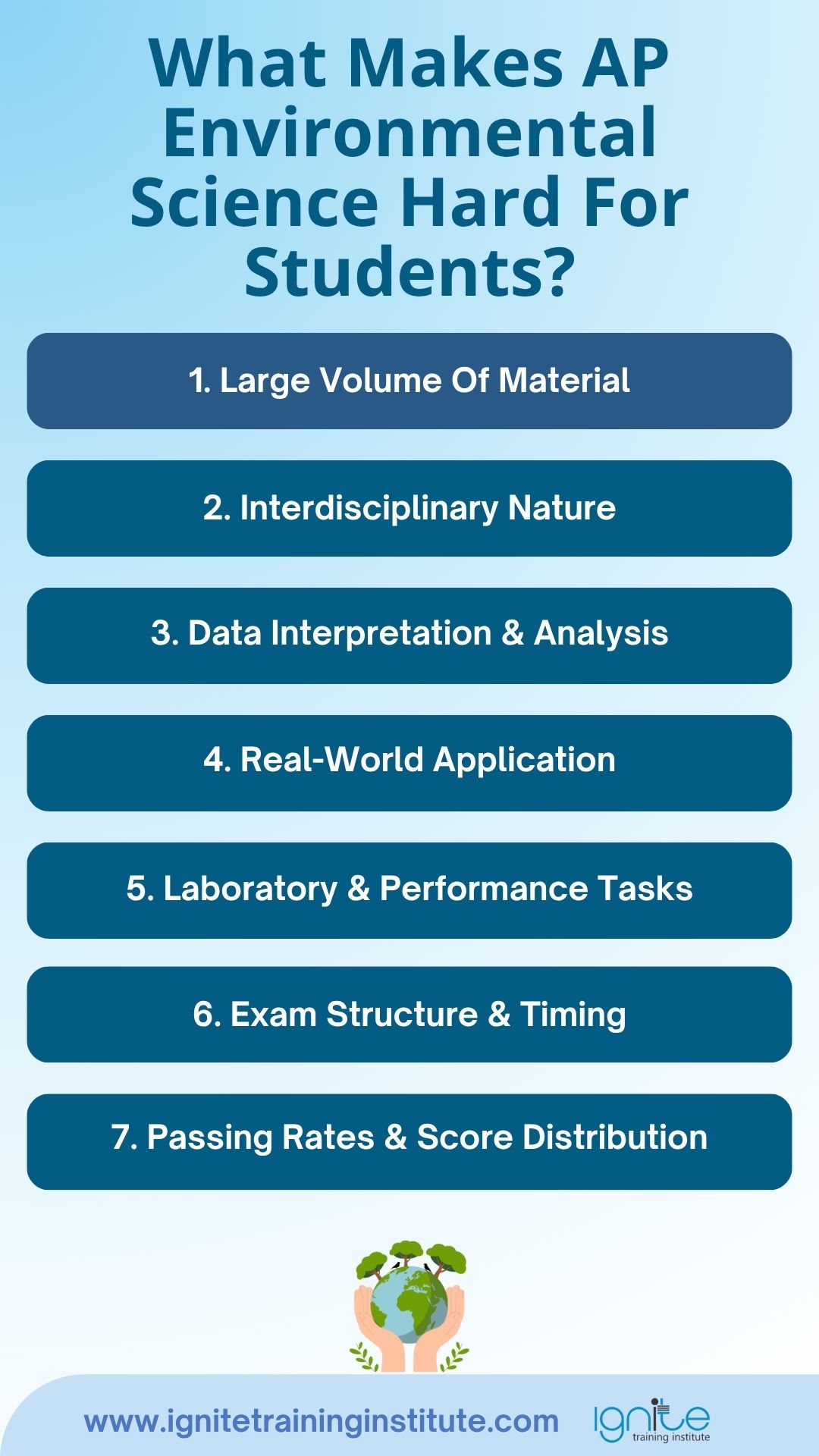
AP Environmental Science (APES) is often considered one of the more approachable AP courses compared to AP Chemistry or AP Physics. However, many students still find it challenging.
The difficulty doesn’t come from complex mathematics or abstract physics laws, but from a combination of factors that test both conceptual understanding and real-world application. Understanding these challenges can help students prepare more effectively.
1. Large Volume Of Material
APES covers a broad range of topics, including:
- Ecosystems and biodiversity
- Biogeochemical cycles (carbon, nitrogen, phosphorus, water)
- Energy resources and consumption
- Pollution and waste management
- Climate change and environmental policy
- Human population dynamics
Why it’s tough: Students must memorize numerous terms, processes, and interactions. Unlike subjects that focus heavily on math, APES requires retaining and connecting a large amount of factual information.
2. Interdisciplinary Nature
APES is highly interdisciplinary, combining biology, chemistry, geology, and social science. For example:
- Understanding acid rain requires knowledge of chemistry, pH, and reactions.
- Calculating ecological footprints uses math and analytical reasoning.
- Environmental policy analysis requires understanding social, political, and economic factors.
Why it’s tough: Students must switch between different disciplines and integrate concepts, which can be overwhelming for those who are stronger in one area than another.
3. Data Interpretation & Analysis
AP Environmental Science exams frequently include:
- Graphs showing population growth or pollution levels
- Charts for energy consumption or species diversity
- Case studies and research scenarios
Why it’s tough: Students must interpret data accurately, draw conclusions, and apply their knowledge to real-world problems. Unlike multiple-choice questions that test memorization, these tasks require critical thinking and analytical skills.
4. Real-World Application
APES is less about memorizing formulas and more about applying knowledge to solve environmental problems. For instance:
- Predicting the impact of deforestation on an ecosystem
- Suggesting sustainable energy solutions for a city
- Analyzing environmental policies and their effectiveness
Why it’s tough: Students often struggle with connecting theoretical knowledge to practical scenarios, especially under timed exam conditions.
5. Laboratory & Performance Tasks
AP Environmental Science includes lab investigations and performance-based tasks (e.g., experiments, research projects). Students must:
- Design experiments
- Collect and analyze data
- Draw conclusions based on evidence
Why it’s tough: Many students are unfamiliar with scientific method application and experimental design, which can make this section daunting.
6. Exam Structure & Timing
The APES exam has two main sections:
- Multiple-Choice Section: 80 questions in 90 minutes
- Free-Response Section: 3 long and 4 short questions in 90 minutes
Why it’s tough: Time management is critical. Students must think quickly, analyze information, and write coherent responses under strict time constraints.
7. Passing Rates & Score Distribution
The pass rate for the APES exam has varied over the years. In 2024, the pass rate was 54.1%, with 9.2% of students scoring a 5, 27.5% scoring a 4, and 17.4% scoring a 3. These figures indicate that while a majority of students pass, achieving higher scores requires a deeper understanding and application of the material. AP Students College Board
Related: Top 5 Easiest AP Exams: A Guide To Achieving Success
The Toughest Concepts In AP Environmental Science
AP Environmental Science (APES) is a course that blends multiple scientific disciplines, including biology, chemistry, geology, and social science, to explore the environment and human impact on it.
While many students find APES more approachable than AP Chemistry or AP Physics, it has its own set of challenging concepts that require focus, analysis, and critical thinking. Understanding these tough areas can help students prioritize their study time effectively.
1. Energy Flow & Ecosystems
- What it covers: Food webs, trophic levels, energy pyramids, and ecosystem productivity.
- Why it’s tough: Students must track how energy moves through ecosystems, understand ecological efficiency, and analyze human impacts on these systems.
- Tip: Visual aids like diagrams of energy pyramids and nutrient cycles help simplify complex interactions.
2. Biogeochemical Cycles
- What it covers: Carbon, nitrogen, phosphorus, sulfur, and water cycles.
- Why it’s tough: Each cycle involves multiple reservoirs, processes, and feedback loops. Misunderstanding even one step can make it difficult to answer questions correctly.
- Tip: Focus on inputs, outputs, and human influence for each cycle. Flashcards can help with memorizing processes and terminology.
3. Population Ecology & Human Impacts
- What it covers: Population growth models, carrying capacity, competition, predation, and human population dynamics.
Why it’s tough: Students must understand mathematical models like exponential vs. logistic growth and relate them to real-world environmental issues. - Tip: Practice applying these models to case studies and interpreting population graphs.
4. Pollution & Toxicology
- What it covers: Types of pollutants (air, water, soil), bioaccumulation, biomagnification, and human health impacts.
- Why it’s tough: Students need to connect chemical and biological principles to understand how pollutants move through ecosystems and affect organisms.
- Tip: Focus on high-impact examples like mercury in fish or DDT, which frequently appear on exams.
5. Climate Change & Energy Resources
- What it covers: Greenhouse effect, carbon footprint, renewable vs. nonrenewable energy, and global warming.
- Why it’s tough: Students must understand complex systems, feedback loops, and policy implications.
- Tip: Keep up with current events and real-world examples, as they help contextualize exam questions.
6. Environmental Policies & Economics
- What it covers: Environmental laws, regulations, international treaties, and cost-benefit analysis of environmental decisions.
- Why it’s tough: This section combines science with social, political, and economic reasoning, which can feel abstract compared to purely scientific concepts.
- Tip: Make a list of key legislation and agreements, such as the Clean Air Act or Kyoto Protocol, and understand their goals and impacts.
7. Lab Investigations & Data Analysis
- What it covers: Experiments involving water quality, soil testing, energy efficiency, and population studies.
- Why it’s tough: Students must design experiments, analyze results, and draw conclusions. Free-response questions often integrate lab-based data.
- Tip: Practice interpreting tables, graphs, and experimental results from past AP exams.
Related: How Many AP Classes To Take For An Ideal Academic Career
When Should You Take AP Environmental Science?
Most students take AP Environmental Science in 11th or 12th grade. By this point, they have typically completed foundational courses such as:
- Biology – Understanding ecosystems, genetics, and cellular processes is essential.
- Chemistry – A basic understanding of chemical reactions, acids and bases, and energy concepts helps with topics like pollution and energy resources.
- Algebra – Useful for analyzing data, interpreting graphs, and performing simple calculations in labs or on exams.
Most students find 11th or 12th grade to be the sweet spot. With the right preparation and interest, APES can be both manageable and highly rewarding, offering a mix of hands-on learning, real-world application, and a pathway to college credit.
Related: Is AP Macroeconomics Hard? A Quick Guide For Students
Is AP Environmental Science Easy To Self-Study
AP Environmental Science (APES) can be self-studied, but its interdisciplinary nature and breadth of content make it moderately challenging without structured guidance. The course covers biology, chemistry, earth science, and social science, along with real-world applications, data analysis, and environmental policies.
Success in self-study requires discipline, organization, and the ability to connect concepts across different fields. Students must also be comfortable interpreting data, analyzing case studies, and understanding real-world environmental issues.
While APES is generally more approachable than courses like AP Chemistry or AP Physics, seeking external help can be highly beneficial. Tutors, online courses, or study groups can provide structured guidance, clarify difficult concepts, and offer targeted practice.
They can also help students focus on high-yield topics, develop effective exam strategies, and avoid common mistakes. Combining self-study with expert support often gives students the confidence and preparation needed to perform well on the APES exam.
Related: Is AP Chemistry Hard? A Complete Guide
Is It Worth Taking AP Environmental Science?
Taking AP Environmental Science (APES) can be highly worthwhile, especially for students interested in understanding how humans interact with the natural world. The course provides a unique blend of science, policy, and real-world applications, offering insight into pressing global issues like climate change, pollution, and sustainable resource management.
Beyond environmental knowledge, APES also develops critical thinking, data analysis, and problem-solving skills that are valuable for college and everyday life.
Additionally, earning a high APES score can give students college credit or advanced placement, potentially saving time and tuition in higher education.
Even for students not pursuing environmental careers, the course’s interdisciplinary approach makes it a manageable and rewarding AP option that strengthens scientific literacy and prepares students for future academic challenges.
Related: Should I Take AP Physics 1, 2, Or C? Know The Differences
AP Environmental Science VS Other AP Science Courses
AP Environmental Science (APES) is often considered one of the more approachable AP science courses, but how does it compare to other AP sciences like AP Biology, AP Chemistry, and AP Physics?
Understanding the differences in content, difficulty, and skill requirements can help students make informed decisions about which courses to take.
1. AP Environmental Science (APES)
- Focus: Human impact on the environment, ecosystems, energy resources, pollution, climate change, and environmental policy.
- Skills Needed: Conceptual understanding, critical thinking, data analysis, and real-world application.
- Math Level: Low to moderate (basic algebra and data interpretation).
- Memorization: Moderate, with emphasis on cycles, species, and environmental laws.
- Difficulty: Considered more manageable than AP Chemistry or AP Physics, but requires interdisciplinary thinking.
2. AP Biology
- Focus: Cellular biology, genetics, evolution, physiology, ecology, and molecular biology.
- Skills Needed: Memorization of processes and structures, conceptual understanding, and analytical thinking.
- Math Level: Low (basic statistics and algebra for data analysis).
- Memorization: High, with extensive terminology and biological processes.
- Difficulty: Moderate; more memorization-heavy than APES, but less math-intensive than AP Chemistry or Physics.
3. AP Chemistry
- Focus: Chemical reactions, thermodynamics, stoichiometry, acids and bases, kinetics, and equilibrium.
- Skills Needed: Strong math skills, problem-solving, and conceptual understanding of chemical processes.
- Math Level: High (algebra, logarithms, basic calculus concepts for advanced topics).
- Memorization: Moderate; understanding concepts is more important than rote memorization.
- Difficulty: High; often considered one of the toughest AP sciences due to abstract concepts and mathematical calculations.
4. AP Physics (1, 2, C)
- Focus: Mechanics, electricity and magnetism, thermodynamics, waves, and in AP C, calculus-based problem solving.
- Skills Needed: Strong math and analytical skills, problem-solving, and conceptual understanding of physical laws.
- Math Level: High (algebra for Physics 1/2, calculus for AP Physics C).
- Memorization: Low to moderate; understanding principles and applying formulas is key.
- Difficulty: High; AP Physics challenges students with abstract reasoning and complex calculations.
5. How APES Stands Out
- Interdisciplinary Approach: Combines biology, chemistry, earth science, and social science, making it unique among AP sciences.
- Real-World Applications: Focuses heavily on environmental issues and human impact, which is less abstract than AP Chemistry or Physics.
- Exam Format: Balanced between multiple-choice questions, free-response questions, and lab-based performance tasks, requiring both conceptual understanding and analytical thinking.
Related: AP Computer Science Principles VS AP Computer Science A
Smart Study Methods For Excelling In AP Environmental Science
Excelling in AP Environmental Science (APES) requires more than just memorization—it calls for strategic, focused study.
- Start by breaking down topics like ecosystems, biogeochemical cycles, and pollution into manageable sections and use concept maps or diagrams to visualize connections.
- Practice with past exams and free-response questions to get familiar with the format and time management.
- Incorporate active learning techniques, such as teaching concepts to a friend, summarizing information in your own words, and analyzing real-world environmental case studies.
- Keeping up with current environmental news also helps contextualize concepts and makes learning more engaging.
- Finally, seeking guidance when needed with tutors, online courses, or study groups can clarify difficult topics and help refine exam strategies.
Related: AP Courses For Engineering: Best Subjects To Prepare
Ignite Training Institute: Best Tutoring Support For AP Environmental Science
At Ignite Training Institute in Dubai, students receive top-tier tutoring support for AP Environmental Science (APES) that goes beyond standard classroom learning.
Our experienced tutors provide personalized guidance, breaking down complex topics like ecosystems, biogeochemical cycles, pollution, and climate change into easy-to-understand concepts.
Through step-by-step explanations, practical exercises, and interactive discussions, students gain the confidence and skills needed to excel in both multiple-choice and free-response sections of the APES exam.
FAQs
1. Which AP science is the easiest?
AP Environmental Science is often considered the easiest AP science because it is less math-intensive and focuses more on real-world applications and conceptual understanding.
2. Is AP Environmental Science Harder Than Biology?
AP Environmental Science is generally considered less difficult than AP Biology, as it requires less memorization and focuses more on broad environmental concepts.
3. What Is The Rule Of 70 In AP Environmental Science?
The Rule of 70 is a formula used to estimate the doubling time of a population: Doubling Time ≈ 70 ÷ Growth Rate (%).
4. What Grade Should I Take AP Environmental Science?
Most students take AP Environmental Science in 11th or 12th grade, after completing foundational courses in biology, chemistry, and algebra.
5. What is the average grade in AP Environmental Science?
The average AP Environmental Science score is typically around 2.7–2.9, with about 54% of students scoring 3 or higher in recent exams.
Conclusion
In conclusion, while AP Environmental Science presents its own set of challenges, especially with its interdisciplinary content and real-world application questions, it remains one of the more manageable AP sciences for many students. It offers not only the opportunity for college credit but also valuable knowledge and skills that are relevant both academically and in everyday life.