Education plays a crucial role in shaping a student’s future and choosing the right curriculum can make all the difference. The Cambridge Curriculum, designed by Cambridge Assessment International Education (CAIE), is one of the most recognized educational frameworks worldwide.
Offering a progressive learning pathway from primary to advanced levels, it focuses on critical thinking, problem-solving, and in-depth subject understanding—preparing students for success in universities and careers globally.
In this blog, we’ll explore the structure, benefits, and grading system of the Cambridge Curriculum, helping you understand why it is a preferred choice for students worldwide.
For students in Dubai, UAE, navigating the Cambridge syllabus can be challenging, but Ignite Training Institute makes it easier. As a leading tutoring center, Ignite provides expert support for IGCSE, A-Levels, and other Cambridge programs, ensuring students master concepts, excel in exams and achieve top scores.

What Is Cambridge Curriculum?
The Cambridge Curriculum is an internationally recognized education system developed by Cambridge Assessment International Education (CAIE), a division of the University of Cambridge. It is designed to provide a flexible and challenging academic framework that prepares students for success in school, university, and beyond. Schools worldwide, especially in over 160 countries, offer this curriculum as an alternative to national curricula.
The Cambridge Curriculum emphasizes critical thinking, independent research, and global perspectives, making it a preferred choice for international schools and students aiming for a well-rounded education.
With a strong emphasis on academic rigor and global perspectives, the Cambridge Curriculum prepares students for higher education and future careers by fostering a deep understanding of subjects rather than rote memorization.
The curriculum is divided into four key stages: Cambridge Primary (5-11 years), Cambridge Lower Secondary (11-14 years), Cambridge IGCSE (14-16 years), and Cambridge Advanced (16-19 years), which includes AS & A-Levels. Each stage builds upon the previous one, ensuring a smooth transition and progressive development of knowledge and skills.
Students are assessed through a combination of examinations, coursework, and practical assessments, allowing for a well-rounded evaluation of their abilities. With its wide range of subject choices and focus on holistic development, the Cambridge Curriculum is ideal for students aiming for top universities worldwide.
Related: Cambridge A-Level Courses: Explore All Your Subject Options
Structure Of The Cambridge Curriculum
The Cambridge Curriculum is divided into different educational stages:
1. Cambridge Primary (Ages 5-11)
This stage builds the foundation for learning through a structured yet adaptable syllabus that includes:
- Core Subjects: English, Mathematics, and Science
- Additional Subjects: Global Perspectives, Digital Literacy, Music, and Physical Education (PE)
- Assessments: Cambridge Primary Checkpoint (optional)
2. Cambridge Lower Secondary (Ages 11-14)
This stage develops key knowledge and skills to help students transition to higher education levels. The subjects offered include:
- Core Subjects: English, Mathematics, and Science
- Other Subjects: Computing, Foreign Languages, Art & Design, and Global Perspectives
- Assessments: Cambridge Lower Secondary Checkpoint (optional)
3. Cambridge Upper Secondary – IGCSE (Ages 14-16)
The International General Certificate of Secondary Education (IGCSE) is the most widely recognized qualification under the Cambridge system.
- Core Subjects: English, Mathematics, Science
- Optional Subjects: Business Studies, Economics, History, Geography, Computer Science, Foreign Languages, and more
- Assessment: Written exams, coursework, and practical assessments
4. Cambridge Advanced – AS & A Levels (Ages 16-19)
This stage provides in-depth subject knowledge and prepares students for university-level education.
- AS Level: Taken in one year, covering half of the A-Level content
- A Level: Taken over two years, offering an advanced understanding of subjects
- Assessment: Written exams, coursework, and practical assessments
Related: What Is The Difference Between Edexcel & Cambridge? 5 Facts
Grading System Of Cambridge Curriculum
The Cambridge curriculum, administered by Cambridge Assessment International Education (CAIE), employs distinct grading systems across its various qualifications to assess and differentiate student performance effectively.
Cambridge IGCSE Grading:
Traditionally, the International General Certificate of Secondary Education (IGCSE) is graded on an A* to G scale:
- A (a)**: Highest level of achievement
- A (a): Excellent performance
- B (b): Good understanding
- C (c): Satisfactory grasp of the subject
- D (d): Moderate understanding
- E (e): Basic knowledge
- F (f): Limited grasp
- G (g): Minimum passing grade
- U: Ungraded, indicating the minimum standard was not met
To align with certain national grading systems, CAIE introduced a 9–1 grading scale in select subjects:
- 9: Highest grade, surpassing the traditional A*
- 1: Lowest passing grade
- U: Ungraded
This dual grading system allows schools to choose the format that best fits their context.
Cambridge International A Levels Grading:
Advanced Level (A Level) qualifications are graded from A* to E:
- A*: Exceptional performance
- A: Excellent understanding
- B: Good performance
- C: Competent understanding
- D: Satisfactory performance
- E: Minimum passing grade
- U: Ungraded
The A* grade is awarded to students who achieve a minimum threshold in both overall and specific assessment components.
Grade Thresholds:
CAIE employs grade thresholds to determine the minimum marks required for each grade in a specific subject. These thresholds can vary based on the exam’s difficulty and the global performance of candidates, ensuring fairness and consistency across different exam series.
Comparison With Other Educational Boards:
Unlike percentage-based assessments common in some educational systems, CAIE’s grading emphasizes a global standard of achievement, providing nuanced insights into student performance. For instance, the A* or 9 grades offer greater differentiation among top-performing students compared to traditional percentage systems.
Related: Cambridge IGCSE: Comprehensive Guide For Parents & Students
Why Choose Cambridge Curriculum?
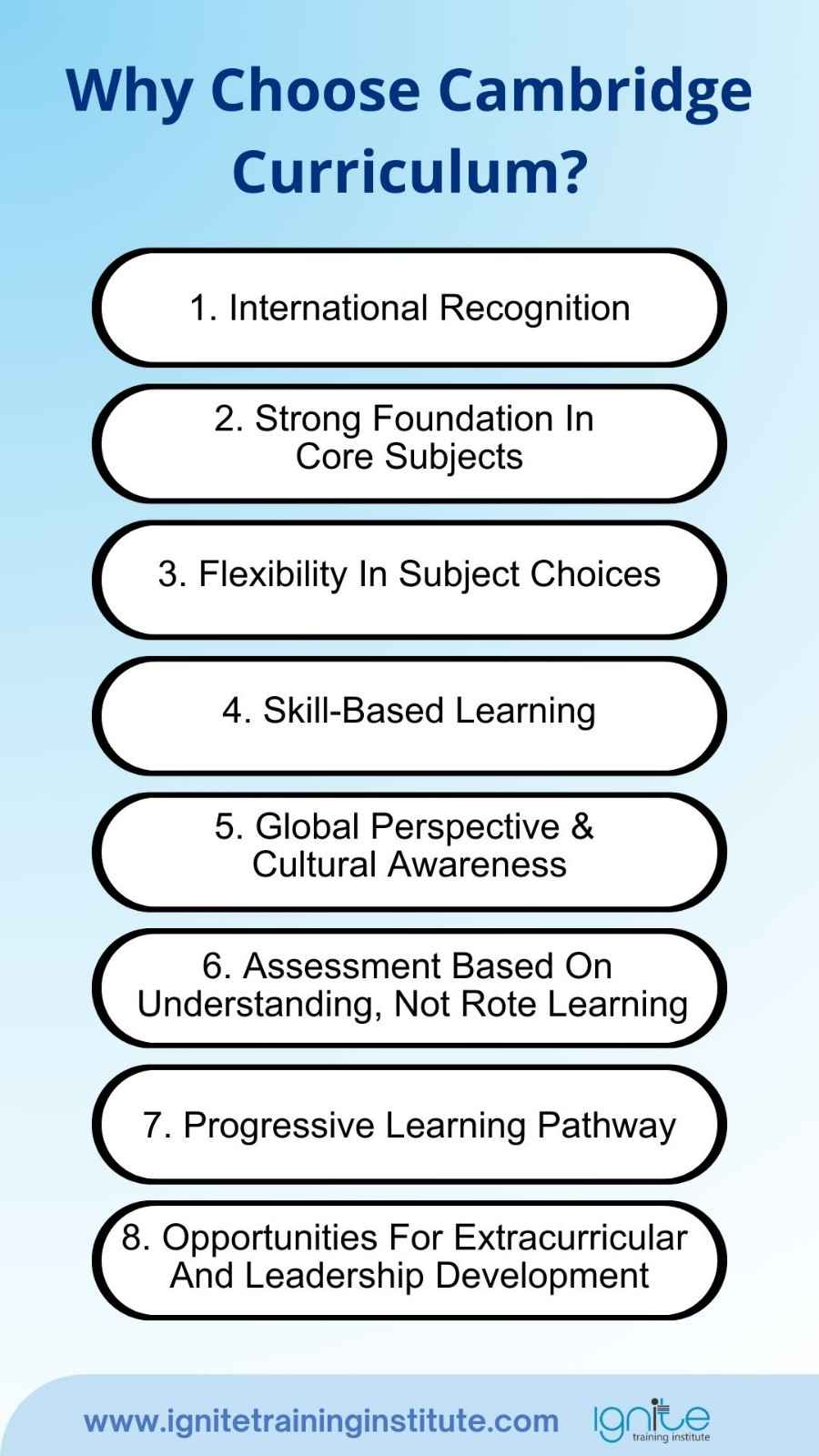
The Cambridge Curriculum, developed by Cambridge Assessment International Education (CAIE), is one of the most widely recognized educational frameworks in the world. It offers a flexible, challenging, and international approach to education, preparing students for higher education and career success. Here’s why the Cambridge Curriculum stands out:
1. International Recognition
The Cambridge qualifications, including IGCSE (International General Certificate of Secondary Education), AS & A Levels, and Cambridge Primary & Lower Secondary, are recognized by top universities and employers worldwide. Prestigious institutions like Harvard, MIT, Oxford, and Cambridge accept Cambridge qualifications as a benchmark for academic excellence.
2. Strong Foundation In Core Subjects
The curriculum emphasizes key subjects like Mathematics, Sciences, Languages, and Humanities, providing students with a balanced education. The IGCSE and A-Level courses focus on deep subject knowledge and critical thinking skills, making students well-prepared for advanced studies.
3. Flexibility In Subject Choices
Unlike many traditional curriculums, Cambridge offers a wide range of subjects. Students can choose subjects that align with their interests and future career aspirations, whether in STEM, Humanities, Business, or the Arts.
4. Skill-Based Learning
The curriculum fosters problem-solving, independent research, creativity, and analytical thinking, ensuring that students are not just memorizing information but applying it to real-world situations. This approach prepares students for university and beyond.
5. Global Perspective & Cultural Awareness
With a global outlook, Cambridge qualifications are taught in over 160 countries, making it an ideal choice for expatriate families and students planning to study abroad. The curriculum encourages an international perspective, helping students appreciate different cultures and viewpoints.
6. Assessment Based On Understanding, Not Rote Learning
Examinations in Cambridge programs are designed to assess a student’s application of knowledge, critical thinking, and problem-solving rather than just recall. This ensures that students develop higher-order thinking skills, which are essential for academic and career success.
7. Progressive Learning Pathway
The Cambridge system follows a structured and seamless progression, from Cambridge Primary (5-11 years), Cambridge Lower Secondary (11-14 years), Cambridge IGCSE (14-16 years), and Cambridge International AS & A Levels (16-19 years). This progression supports continuous development and ensures that students build a strong foundation before advancing to higher levels.
8. Opportunities For Extracurricular And Leadership Development
Many Cambridge schools offer extracurricular programs, research projects, and leadership opportunities that complement academic studies, making students well-rounded and confident individuals.
Related: Guide To A-Levels Subjects For Different Career Options
Is Cambridge Syllabus Tougher Than CBSE?
The Cambridge curriculum (CAIE – Cambridge Assessment International Education) and the CBSE (Central Board of Secondary Education) are two of the most popular educational boards in India and globally. Many parents and students often wonder: Is the Cambridge syllabus tougher than CBSE? The answer depends on various factors such as learning style, assessment methods, and subject depth. Let’s break it down.
1. Depth of Learning: Conceptual vs. Rote Learning
- Cambridge Curriculum: Focuses on concept-based learning and encourages students to apply knowledge rather than memorize facts. Subjects like Mathematics, Sciences, and English require critical thinking, analysis, and problem-solving skills.
- CBSE: While CBSE has introduced some conceptual learning elements, it still relies more on rote learning and standardized textbooks. Students are expected to follow NCERT books and prepare for direct questions in exams.
Cambridge is more concept-driven, while CBSE follows a structured, syllabus-based approach.
2. Exam & Assessment Patterns
- Cambridge Curriculum: Assessments in IGCSE and A-Levels include application-based questions, case studies, and research work. The grading is broader (A* to G) and includes practical understanding rather than just theory.
- CBSE: Follows a fixed exam pattern, with a focus on board exams in Class 10 and Class 12. The exams mainly include direct and structured questions that test how well a student remembers textbook content.
Cambridge exams are tougher due to their analytical nature, while CBSE exams are straightforward but highly competitive.
3. Flexibility in Subject Choices
- Cambridge: Offers over 70 subjects in IGCSE and a flexible combination at A-Levels. Students can mix subjects from different disciplines, such as Mathematics with Arts or Business with Science.
- CBSE: Has fixed subject groupings (Science, Commerce, Arts), with limited flexibility in choosing electives.
Cambridge offers greater flexibility, whereas CBSE follows a fixed structure.
4. Global Recognition & University Admissions
- Cambridge: Recognized worldwide by top universities like Harvard, Oxford, MIT, and Cambridge University. Students with A-Level or IGCSE qualifications often find it easier to transition into international universities.
- CBSE: Accepted mainly in Indian universities and some international institutions, but students may need to take additional entrance tests like SAT, ACT, or AP exams to qualify for universities abroad.
Cambridge is better for international education, while CBSE is ideal for Indian universities.
5. Workload & Difficulty Level
- Cambridge: Since it is application-based, students need to put in extra effort for research, projects, and detailed understanding. This makes the syllabus challenging and time-intensive.
- CBSE: Though rigorous, CBSE focuses on scoring well in exams rather than in-depth research. It has a structured and predictable pattern, making it easier for students who prefer textbook learning.
Cambridge is tougher due to its in-depth approach, while CBSE is easier to follow but competitive in terms of exam scoring.
Related: Is O Level And IGCSE The Same? Differences & How To Choose
Related: A-Level Subjects & Choices For Best Subject Combinations
Ignite Training Institute: IGCSE & A-Levels Tutors In Dubai, UAE
Ignite Training Institute is a premier tutoring center in Dubai, specializing in IGCSE, A-Levels, IBDP, MYP, AP, and homeschooling support. With a proven track record of over 2,200+ student success stories, Ignite offers expert tutoring to help students achieve top scores, including 7/7 in IBDP and A in A-Levels*. Our highly qualified tutors provide personalized learning plans, exam strategies, and subject mastery to ensure students excel in their academics.
Located in JLT, Dubai, Ignite Training Institute is the go-to choice for students seeking comprehensive academic support, revision courses, and test preparation. Whether you need help with Mathematics, Science, Business, or Humanities, our experienced faculty is dedicated to boosting your confidence and performance. Join Ignite today and achieve academic excellence!
Related: Is O Level And IGCSE The Same? Differences & How To Choose
FAQs
1. Is The Cambridge Curriculum Better Than CBSE?
The Cambridge Curriculum is more concept-based and internationally recognized, while CBSE is structured and better suited for Indian competitive exams. The best choice depends on a student’s academic goals and learning style.
2. What Is A Cambridge Curriculum?
The Cambridge Curriculum, developed by Cambridge Assessment International Education (CAIE), is a globally recognized education system that emphasizes critical thinking, problem-solving, and in-depth subject understanding from primary to advanced levels.
3. What Is The Syllabus Of Cambridge?
The Cambridge syllabus varies by level—Cambridge Primary, Lower Secondary, IGCSE, AS & A Levels—and covers subjects like Mathematics, Science, Humanities, Business, and Languages, with an emphasis on analytical skills and real-world application.
4. What Is The Cambridge Method Of Teaching?
The Cambridge teaching methodology focuses on active learning, inquiry-based approaches, and practical application. It encourages critical thinking, independent research, and collaborative learning rather than rote memorization.
5. Is The Cambridge Curriculum Hard?
Yes, the Cambridge Curriculum is challenging as it requires deep conceptual understanding, analytical thinking, and application-based learning. However, with the right support, like Ignite Training Institute, students can excel.
6. Which Curriculum Is Best In India?
The best curriculum in India depends on individual goals—CBSE is ideal for national entrance exams like JEE & NEET, while Cambridge (IGCSE & A-Levels) is best for international education and global career opportunities.
7. How Many Subjects Are There In The Cambridge Curriculum?
The Cambridge Curriculum offers over 70 subjects at different levels, including IGCSE and A-Levels, giving students the flexibility to choose subjects based on their interests and career aspirations.
8. What Subjects Can You Study In Cambridge?
Cambridge offers a wide range of subjects, including Mathematics, Sciences, Business, Economics, Computer Science, Humanities, Arts, and Languages, allowing students to tailor their education to their strengths.
9. What Are The Subjects In The Cambridge Primary Curriculum?
The Cambridge Primary Curriculum includes core subjects like English, Mathematics, Science, Global Perspectives, Computing, and Art & Design, designed to build a strong academic foundation from an early stage.
Conclusion
The Cambridge Curriculum is a globally recognized education system that nurtures critical thinking, problem-solving, and academic excellence. With its flexible subject choices, skill-based assessments, and international credibility, it prepares students for success in top universities and careers worldwide.
While it may be more challenging than traditional curriculums, its emphasis on conceptual learning and real-world application makes it a preferred choice for students aiming for a well-rounded education.