Choosing the right subjects during your IGCSE years is an important step towards a successful career in medicine. The foundation of medical knowledge begins early, and selecting the right combination of subjects can set you on the right path to pursue this rewarding field.
While medical schools often focus on A-level qualifications, your IGCSE subjects play a key role in building the necessary scientific understanding and analytical skills needed for higher education in medicine.
In this blog, we’ll explore the best IGCSE subjects that will help you prepare for a future in medicine. From Biology and Chemistry to Physics and Mathematics, each subject plays an integral role in understanding the complexities of the human body and the science behind healthcare.
At Ignite Training Institute, we offer expert tutoring support for IGCSE subjects, ensuring that students have the guidance and resources to excel in these foundational courses. Whether you’re aiming for a career in medicine or any other field, our tutors are here to help you succeed.

What Are The IGCSE Subjects For Medicine?
If you are planning to pursue a career in medicine, selecting the right subjects during your IGCSE years is crucial. While medical schools typically have specific A-Level and university requirements, your IGCSE choices lay the foundation for your future studies in science and healthcare. Here’s a guide to help you choose the most relevant IGCSE subjects for medicine:
1. Biology
- Why it’s important: Biology is the cornerstone of medicine, providing an in-depth understanding of living organisms, human biology, and how our bodies function. It will prepare you for advanced medical topics, including human anatomy, physiology, genetics, and health-related sciences.
- What you’ll study: Cells, tissues, organs, systems of the body, genetics, health and disease.
2. Chemistry
- Why it’s important: Chemistry is vital for understanding the biochemical processes that occur in the body, such as how drugs interact with cells and tissues. This subject will give you a strong grounding in the sciences that underpin pharmacology and medical treatment.
- What you’ll study: The structure and properties of matter, chemical reactions, the periodic table, and organic chemistry.
3. Physics
- Why it’s important: Physics may seem less directly related to medicine, but it plays a significant role in understanding technologies used in medical imaging, medical equipment, and physical principles that impact human health, such as mechanics and motion.
- What you’ll study: Forces and motion, energy, electricity, magnetism, and basic principles of sound and light, including how they apply to medical technologies.
4. Mathematics
- Why it’s important: Medicine requires a solid understanding of mathematics for tasks like calculating drug doses, interpreting medical statistics, and understanding data from medical research. A strong foundation in mathematics is also valuable for problem-solving and critical thinking in medical scenarios.
- What you’ll study: Algebra, geometry, statistics, and the basics of calculus (depending on the curriculum).
5. English
- Why it’s important: Strong communication skills are crucial in medicine, as you’ll need to communicate with patients, colleagues, and other healthcare professionals. English is also necessary for understanding medical literature, research papers, and ethical guidelines in the medical field.
- What you’ll study: Reading comprehension, writing essays, and improving communication skills.
6. Additional Science (If Available)
- Why it’s important: Some schools offer IGCSE Additional Science, which combines elements of Biology, Chemistry, and Physics into a comprehensive course. This subject can give you a more rounded scientific foundation for medicine.
- What you’ll study: A combination of biological, chemical, and physical sciences, focusing on key principles across the three disciplines.
7. Psychology (Optional But Useful)
- Why it’s useful: Understanding human behavior, cognition, and emotions is important for anyone entering medicine. This subject can provide insight into patient care, mental health, and communication with patients, especially those with psychological conditions.
- What you’ll study: Human development, behavior, mental health disorders, and therapeutic techniques.
8. Other Humanities Or Social Sciences (Optional But Beneficial)
- Why they are beneficial: While not directly related to medicine, subjects like Sociology or Ethics can help you understand the social and ethical issues surrounding healthcare. These subjects encourage critical thinking and a broader perspective on healthcare systems, health disparities, and public health.
- What you’ll study: Social behavior, healthcare systems, moral and ethical decision-making in medicine.
Recommended IGCSE Subject Combination For Medicine:
To set yourself up for success in medicine, aim for a balanced combination of the following subjects:
- Biology
- Chemistry
- Mathematics
- Physics
- English
Choosing these core subjects will give you a strong foundation for your A-Levels and medical school studies. You can also consider adding optional subjects like Psychology or Social Sciences to enhance your understanding of the human condition, which is vital in medicine.
Related: IGCSE VS CBSE: Ultimate Comparison With 6 Key Differences
What Subjects Do You Need To Study Medicine At Cambridge?
If you’re aspiring to study medicine at Cambridge, you’ll need to meet specific academic requirements to be considered for entry into this prestigious course. The University of Cambridge is known for its rigorous selection process, ensuring only the most dedicated and academically strong students are chosen. Here’s a guide on the subjects you’ll need to focus on:
1. Biology
- Why it’s required: As a foundational science for medical studies, Biology is essential for understanding human anatomy, physiology, and disease processes. Cambridge expects students to have a strong grasp of biological concepts as they are fundamental to the entire medical curriculum.
- What you’ll study: Cell biology, genetics, biochemistry, and human biology.
2. Chemistry
- Why it’s required: Chemistry plays a critical role in medicine, particularly in biochemistry, pharmacology, and understanding metabolic processes. It’s also vital for understanding how drugs interact with the body and the biochemical basis of diseases.
- What you’ll study: Organic, inorganic, and physical chemistry, along with medicinal chemistry in later stages of your studies.
3. Mathematics (Optional But Preferred)
- Why it’s preferred: While not an official requirement for medicine at Cambridge, Mathematics is highly encouraged. It helps with developing problem-solving skills and a solid understanding of statistics, which is valuable for analyzing medical data and research findings.
- What you’ll study: Algebra, calculus, and statistics (especially applied in medicine).
4. Physics (Optional But Beneficial)
- Why it’s beneficial: Physics provides a solid foundation in understanding the mechanics of the body, the application of medical technologies, and the principles of medical imaging (like MRI and X-rays).
- What you’ll study: Mechanics, thermodynamics, electromagnetism, and waves.
5. Other Subjects (Humanities Or Social Sciences)
- Why they can be helpful: Although they are not necessary for the Cambridge Medicine course, subjects such as Psychology, Philosophy, or Sociology may provide you with a broader understanding of the human experience, social contexts of health, and ethical considerations in medicine.
- What you’ll study: Social issues related to healthcare, medical ethics, and understanding human behavior.
A-Level Or Equivalent Requirements
For students in the UK, Cambridge typically requires three A-Levels, including Biology and Chemistry, with a third subject that can either be another science or a subject like Mathematics or Physics. International students applying with other qualifications should check Cambridge’s website for equivalencies to ensure they meet the requirements.
Additional Considerations:
- Admissions Tests: Alongside subject prerequisites, you’ll need to sit the BioMedical Admissions Test (BMAT), which assesses your scientific knowledge and critical thinking abilities.
- Personal Statement and Interview: Cambridge places significant weight on your personal statement and interview performance, where you’ll need to demonstrate your passion for medicine, your academic strengths, and your ability to think critically.
Related: Top Universities That Accept IGCSE Certificate In USA & UK
Common Challenges In The IGCSE Pathway For Aspiring Medical Students
The IGCSE curriculum is a solid foundation for students aspiring to enter the medical field. It provides a well-rounded education, emphasizing critical thinking and subject depth. However, students on this path face unique challenges that require strategic planning and consistent effort. Here are some common challenges encountered by IGCSE students aiming for medical careers:
1. Selecting The Right Subjects
Aspiring medical students must choose a combination of subjects that align with medical school prerequisites. Core subjects like Biology, Chemistry, and Physics are essential, while Mathematics and English remain compulsory. The challenge arises in balancing additional subjects such as Psychology or Physical Education, which could add to the workload but also enhance a student’s profile.
2. Managing A Heavy Workload
Medical aspirations demand academic excellence. IGCSE students often struggle with the demanding coursework, as science subjects require in-depth understanding, practical applications, and consistent revision. Balancing school assignments, external exams, and extracurricular activities can become overwhelming.
3. Developing Strong Analytical & Practical Skills
Success in medical fields depends on strong analytical and practical skills. IGCSE science subjects include practical components that test students’ ability to apply theoretical knowledge. Some students may find it challenging to master lab work, interpret experimental data, or understand complex biological processes.
4. Excelling In Competitive Exams
Many universities require additional entrance exams like the BMAT, UCAT, or NEET alongside IGCSE qualifications. Preparing for these exams while managing IGCSE coursework can be daunting. Students must develop efficient study habits and time management skills to handle both academic and entrance test requirements.
5. Maintaining High Academic Performance
Medical schools often have stringent grade requirements. Achieving top grades in IGCSE sciences is crucial, as universities look for strong academic backgrounds. Students may face pressure to consistently perform well, which can lead to stress and burnout if not managed properly.
6. Gaining Relevant Experience
Beyond academic success, medical schools value practical experience, such as internships, job shadowing, or volunteering at hospitals and clinics. However, finding relevant opportunities while studying for IGCSE can be difficult, especially for students with limited access to medical institutions.
7. Navigating University Applications
The process of applying to medical schools is complex and varies across countries. Some universities require specific subject combinations, while others emphasize extracurricular achievements and personal statements. Understanding these requirements early and planning accordingly can be a challenge for students and parents alike.
Related: Is O Level And IGCSE The Same? Differences & How To Choose
5 Tips To Score A* In IGCSE Subjects For Medicine
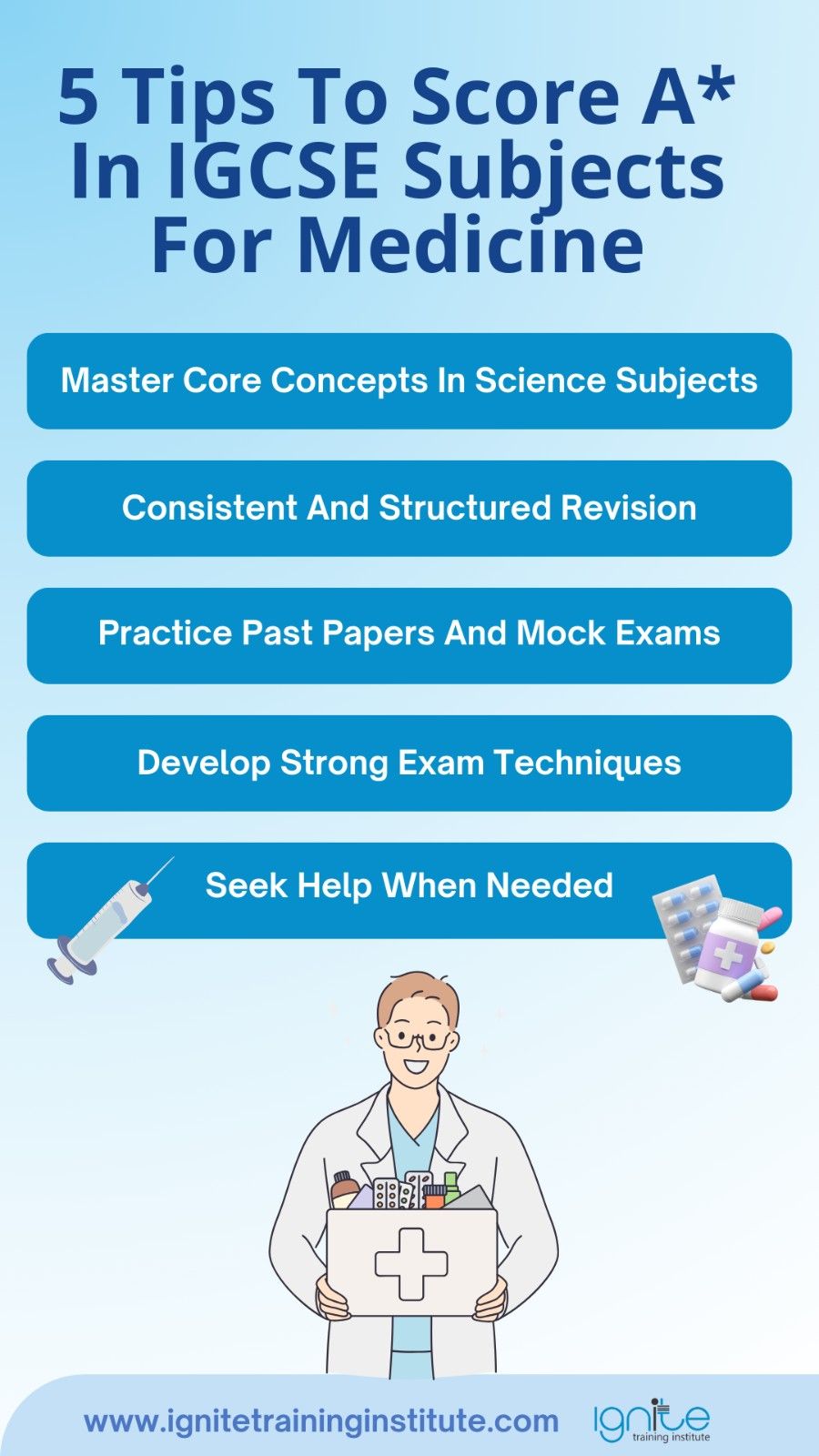
Scoring an A* In IGCSE subjects for medicine requires dedication, effective study strategies, and a strong understanding of the subjects. Here are five tips to help students excel:
1. Master Core Concepts In Science Subjects
For subjects like biology, chemistry, and physics, it’s crucial to build a strong understanding of the core concepts early on. Focus on grasping fundamental theories and principles rather than memorizing facts.
Use textbooks, revision guides, and online resources to clarify difficult topics. Practice applying your knowledge to real-world examples, as this will help in exams where the application of concepts is tested.
2. Consistent And Structured Revision
Start revising well in advance, breaking down your study sessions into manageable chunks. Create a study timetable that allows for consistent review of each subject.
Allocate extra time for the subjects that require more effort, such as chemistry and physics, which can be more challenging for many students. Regular revision ensures that the information stays fresh and reduces the chances of cramming before exams.
3. Practice Past Papers And Mock Exams
One of the best ways to prepare for IGCSE exams is by practicing past papers and taking mock exams. This helps familiarize you with the exam format, time constraints, and the types of questions that are typically asked.
Regularly solving past papers will also highlight areas where you need to improve and refine your exam technique, such as how to structure your answers and manage your time effectively.
4. Develop Strong Exam Techniques
Understanding how to approach each exam is key to scoring well. For science subjects, practice writing clear and concise answers, especially for structured questions.
Pay attention to command words such as “explain,” “describe,” and “compare,” as they determine the depth of your answer. In subjects like mathematics, focus on problem-solving techniques and practice calculations to increase your speed and accuracy.
5. Seek Help When Needed
If you’re struggling with certain topics or concepts, don’t hesitate to ask for help. Reach out to your teachers, tutors, or peers for clarification. You can also join study groups or access online resources to reinforce your understanding. It’s important to address difficulties early on to avoid falling behind in your studies.
By staying organized, practicing consistently, and refining your exam techniques, you can maximize your chances of scoring an A* in IGCSE subjects and set a solid foundation for pursuing medicine.
Related: IGCSE Subjects Choices: Navigate Your Options For The Future
Top Universities Offering Medicine For IGCSE Students
For IGCSE students aiming to pursue medicine, several top universities around the world offer excellent medical programs. These institutions are known for their rigorous admissions processes and high standards. Here’s a list of some of the top universities offering medicine:
1. University Of Cambridge (UK)
- Program: Medicine (MBBS)
- Requirements: Cambridge expects students to have excellent A-levels (including biology and chemistry) or equivalent qualifications. Strong GCSE/IGCSE results, particularly in science subjects, are essential. The university also requires the BMAT (Biomedical Admissions Test) for admission.
- Why It’s Top: Known for its rigorous academic environment and research-driven medical program, Cambridge provides a comprehensive education that combines practical and theoretical aspects of medicine.
2. University Of Oxford (UK)
- Program: Medicine (BM BCh)
- Requirements: Oxford requires A-levels in biology and chemistry, with a strong third subject. A*AA or equivalent results are typically expected. The university also uses the BMAT as part of the selection process.
- Why It’s Top: Oxford’s medical program is highly regarded globally, emphasizing both scientific research and clinical training. The course offers a blend of pre-clinical and clinical stages.
3. Imperial College London (UK)
- Program: Medicine (MBBS)
- Requirements: Imperial requires biology and chemistry at A-level, and often asks for an additional subject. Strong GCSE/IGCSE grades, particularly in science and mathematics, are essential. The BMAT is also required.
- Why It’s Top: Imperial is one of the leading universities for medical research and training. Its focus on innovation in medical science and clinical practice makes it a top choice for aspiring doctors.
4. King’s College London (UK)
- Program: Medicine (MBBS)
- Requirements: Applicants need biology and chemistry at A-level (or equivalent). GCSE/IGCSEs in science subjects are important, and a strong personal statement and relevant work experience are also valued.
- Why It’s Top: King’s College London has one of the largest medical schools in the UK and offers a dynamic medical curriculum with a strong emphasis on patient-centered care and medical ethics.
5. University College London (UCL) (UK)
- Program: Medicine (MBBS)
- Requirements: UCL requires biology and chemistry at A-level, and often a third subject like mathematics or physics. High GCSE/IGCSE results are expected, and the university requires the BMAT for admissions.
- Why It’s Top: UCL’s medical program combines cutting-edge research with clinical training. It is known for its innovative approach to medical education and strong links with hospitals in London.
6. National University Of Singapore (NUS) (Singapore)
- Program: Medicine (MBBS)
- Requirements: NUS requires high grades in science subjects at A-level (or equivalent). IGCSE students should have strong grades in biology, chemistry, and mathematics. NUS also requires a medical school entrance exam and interviews.
- Why It’s Top: NUS is consistently ranked as one of the top universities in Asia and offers a rigorous medical program that prepares students for a wide range of medical specialties.
7. Monash University (Australia)
- Program: Medicine (MBBS)
- Requirements: Monash requires high marks in biology and chemistry at A-level (or equivalent). IGCSE students should aim for excellent results in science subjects. The university uses the UCAT (University Clinical Aptitude Test) as part of the selection process.
- Why It’s Top: Monash offers a world-class medical education with an emphasis on practical training. The university has a strong reputation for research in medical science and health care.
8. University Of Melbourne (Australia)
- Program: Medicine (MD – Doctor of Medicine)
- Requirements: The University of Melbourne offers a graduate-entry medical program, meaning you must first complete a relevant undergraduate degree (such as a Bachelor of Science) before applying for the MD program. IGCSE students can start by pursuing an undergraduate degree in a relevant field and then apply for the MD.
- Why It’s Top: The University of Melbourne is renowned for its medical research and has a comprehensive clinical training program that prepares students for careers in various medical fields.
9. Karolinska Institute (Sweden)
- Program: Medicine (MD)
- Requirements: Applicants must have strong grades in science subjects, and IGCSE students should focus on achieving top marks in biology, chemistry, and mathematics. The application process also includes a series of interviews and exams.
- Why It’s Top: The Karolinska Institute is one of the world’s leading medical universities and is known for its research in medical science and public health. It is also responsible for awarding the Nobel Prize in Physiology or Medicine.
10. Hong Kong University (HKU) (Hong Kong)
- Program: Medicine (MBBS)
- Requirements: HKU requires biology and chemistry at A-level (or equivalent). IGCSE students should achieve excellent grades in relevant science subjects. HKU uses an interview process and requires a high level of English proficiency.
- Why It’s Top: HKU is one of the top medical schools in Asia and offers a world-class medical education with a strong emphasis on research, clinical practice, and healthcare policy.
These universities offer highly competitive and rigorous medical programs, with a focus on scientific research, clinical training, and healthcare innovation. Aspiring medical students should aim to meet their specific entry requirements, including excellent IGCSE and A-level results, work experience, and relevant entrance exams like the BMAT, UCAT, or others.
Related: SAT VS IGCSE: 5 Key Differences Explained
Ignite Training Institute: Best IGCSE Tutors In Dubai
Ignite Training Institute in Dubai offers top-tier IGCSE tutoring, specializing in subjects like mathematics, science, and languages. Their experienced tutors focus on providing personalized learning to cater to individual student needs, ensuring effective understanding of complex concepts.
The institute’s approach involves assessing students’ strengths and weaknesses, tailoring study plans to help them improve and build confidence. Flexible scheduling options are also available, allowing students to balance their studies with other activities.
Ignite also emphasizes exam preparation, offering mock exams and strategies to enhance time management and test-taking skills. This comprehensive approach makes it a leading choice for IGCSE tutoring in Dubai.
Related: IGCSE Economics Course Overview & Past Paper Resources
FAQs
1. Which Subjects Are Best For Medicine In IGCSE?
For medicine, it is recommended to take IGCSE subjects such as Biology, Chemistry, and Physics, along with Mathematics and English, as they provide the foundational knowledge needed for medical studies.
2. What IGCSE Subjects Are Needed For Medicine In The UK?
To pursue medicine in the UK, IGCSE students should focus on Biology, Chemistry, Physics, and Mathematics, as well as English, to meet university entry requirements.
3. What Are The Best Subjects To Take In IGCSE?
The best subjects for IGCSE depend on future goals. However, Biology, Chemistry, Mathematics, English, and Physics are often considered essential for students aiming for science-related careers.
4. What IGCSE Subjects Are Needed For Medicine In Egypt?
In Egypt, students aspiring to study medicine should focus on Biology, Chemistry, Physics, and Mathematics, as these are critical subjects for medical school admission.
5. Which Subject Is Hardest For IGCSE?
The difficulty of IGCSE subjects can vary by individual, but subjects like Mathematics, Physics, and Chemistry are often considered challenging due to their complex concepts.
6. Can IGCSE Students Become Doctors?
Yes, IGCSE students can become doctors by pursuing medical studies after completing A-levels or equivalent qualifications, followed by medical school and training.
7. Can IGCSE Students Appear For NEET?
IGCSE students can appear for NEET if they meet the eligibility criteria, including completing the required subjects (Physics, Chemistry, and Biology) and the age limit.
8. Is IGCSE Harder Than CBSE?
IGCSE is considered more concept-based and offers a more flexible curriculum, while CBSE is structured with a focus on rote learning. The difficulty depends on the student’s learning style.
9. What Subjects Do You Need To Study Medicine At Cambridge?
To study medicine at Cambridge, you typically need A-levels in Chemistry and Biology, along with Mathematics or Physics. IGCSE students should take relevant subjects like Biology and Chemistry.
10. Which Is The Easiest IGCSE Subject?
Subjects like art, physical education, and business studies are often considered less challenging than core science subjects, though they depend on the student’s strengths.
11. Which Is The Toughest Subject In The World?
The toughest subject in the world is subjective, but subjects like Mathematics, Physics, and Engineering are often considered the most challenging due to their complex problem-solving nature.
12. Is Biology IGCSE Hard?
Biology IGCSE can be challenging due to its vast content and need for understanding complex biological processes, but with proper study techniques, it can be manageable.
Conclusion

In conclusion, selecting the right IGCSE subjects for medicine is essential for building a solid foundation. Science subjects like Biology, Chemistry, and Physics are crucial, along with Mathematics and English for developing key skills. Understanding medical school entry requirements can guide students in making informed choices. A mix of core subjects and other areas like humanities can offer a well-rounded educational learnings.
Related: IGCSE Accounting: Syllabus Overview & Key Takeaways