While O Level and IGCSE are similar in that they both represent internationally recognized secondary school qualifications, they differ in scope and focus.
The O Level is a British qualification, traditionally offered through the UK’s General Certificate of Education, while the IGCSE (International General Certificate of Secondary Education) is tailored for an international student base with a more global curriculum. Both are considered equivalent to the 10th-grade level in many educational systems.
Ignite Training Institute provides specialized tutoring support in Dubai for students taking IGCSE and A-Levels. The team of experienced tutors offers personalized guidance, helping students excel in exams and develop a deep understanding of the subjects.
Is O Level And IGCSE The Same? 7 Key Differences Explained
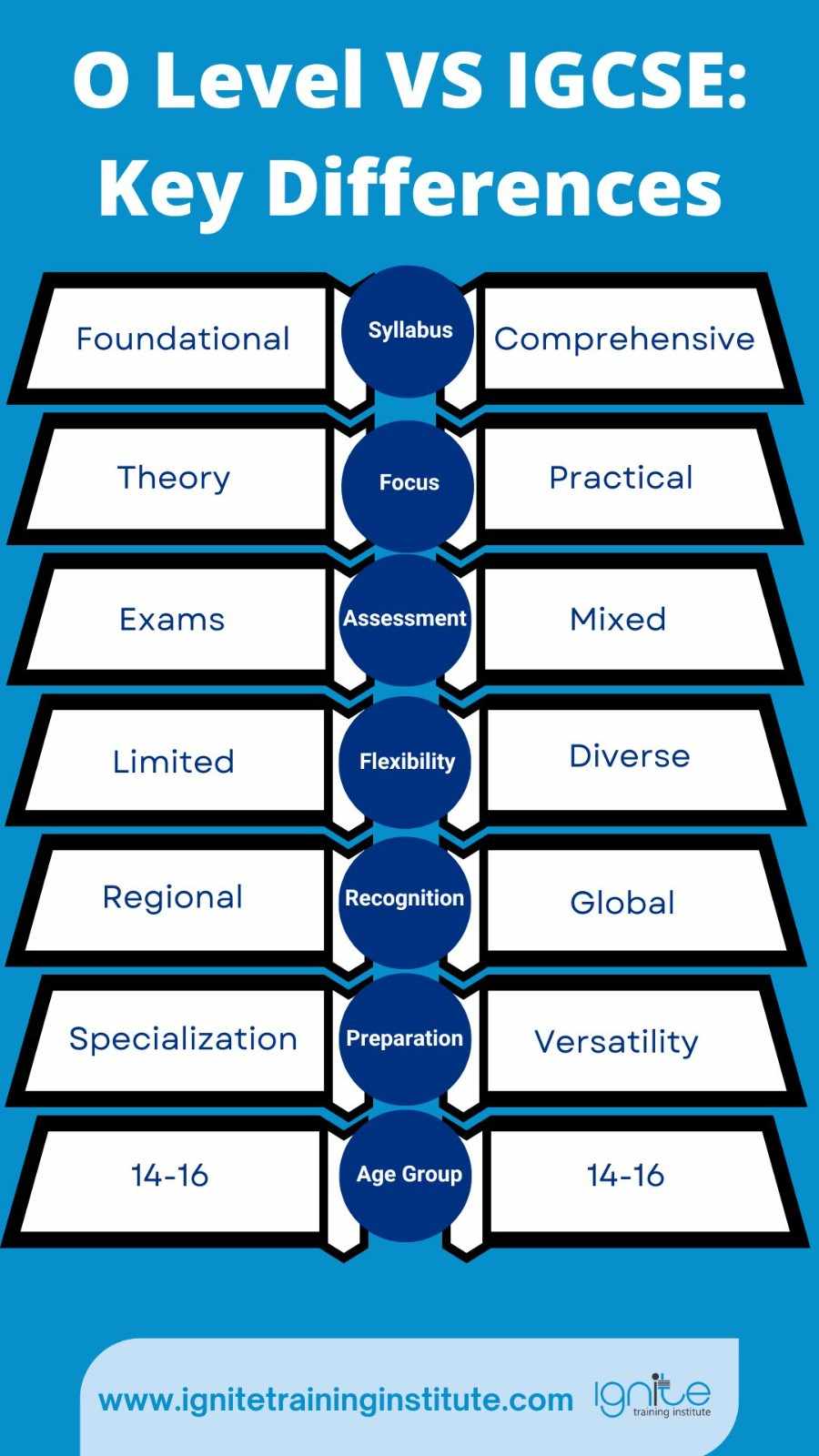
The O Level (Ordinary Level) and IGCSE (International General Certificate of Secondary Education) are two popular academic qualifications offered at the secondary school level. While they share some similarities, they are distinct in several ways that impact students’ learning experiences, assessment styles, and educational pathways.
Here’s a breakdown of the six key differences between O Level and IGCSE to help you understand which is the better fit for your academic goals.
1. Syllabus Structure & Content
- O Level: Developed by Cambridge Assessment International Education, the O Level curriculum is traditionally structured, focusing on essential knowledge in each subject. It’s especially popular in certain regions, like South Asia, and tends to emphasize foundational principles and practical applications.
- IGCSE: Also developed by Cambridge, the IGCSE offers a more comprehensive curriculum designed to be globally inclusive. IGCSE subjects may delve deeper into topics and often include an international perspective, making it ideal for students who wish to study abroad or have a well-rounded global outlook.
2. Focus On Theory vs. Application
- O Level: The O Level curriculum places a strong emphasis on theoretical understanding. The learning process often involves memorization and a detailed understanding of the syllabus, preparing students for higher secondary exams where theoretical depth is essential.
- IGCSE: With its more balanced approach, IGCSE encourages both theoretical learning and practical application. Many subjects include coursework, practical projects, and problem-solving exercises that develop critical thinking and analytical skills, preparing students for the demands of real-world scenarios.
3. Assessment & Grading System
- O Level: Assessments are typically conducted through a series of exams at the end of the course. Grades are awarded based on a letter system from A* to E, with each grade reflecting the student’s performance in exams.
- IGCSE: In IGCSE, students are graded on a scale from A* to G. The grading system is more flexible, often including a mix of written exams and internal assessments, such as coursework. This approach can be beneficial for students who excel in continuous assessment over single, high-stakes exams.
4. Flexibility & Subject Options
- O Level: The O Level curriculum offers a relatively limited selection of subjects, focusing on core academic areas. Students may find it slightly less flexible in terms of course selection.
- IGCSE: IGCSE provides a wider range of subjects and electives, allowing students to tailor their studies to their personal interests or career goals. This variety helps students explore diverse fields, including arts, languages, and vocational subjects, promoting a more holistic education.
5. Global Recognition & University Pathways
- O Level: O Level is widely recognized in countries that follow the British education system, like Singapore and Mauritius. It’s a respected qualification for entering pre-university programs but may require an additional year of study for students aiming for international universities.
- IGCSE: The IGCSE qualification enjoys broader global recognition and is often the preferred choice for students who plan to pursue higher education in international institutions. It’s widely accepted as an equivalent to GCSE in the UK and is valued by universities worldwide, making it easier to transition into diverse international programs.
6. Preparation For Future Studies
- O Level: O Level is designed to lead into A Level studies or equivalent pre-university courses. It provides a strong foundation for students who wish to specialize early in core academic subjects.
- IGCSE: IGCSE provides a broader base that prepares students for multiple pathways, including A Levels, the IB Diploma, and other international curriculums. The diverse skills developed in IGCSE can give students an advantage in adapting to various study environments.
7. Curriculum Overview and Age Group
- O Level: The O Level curriculum is structured for students aged 14 to 16, typically covered over two years (equivalent to Years 10 and 11 in the British system). It focuses on foundational subjects and is particularly geared toward preparing students for advanced studies in specific disciplines, often leading to A-level coursework.
- IGCSE: Designed for a similar age group of 14 to 16-year-olds, the IGCSE curriculum spans two years, generally covering Years 10 and 11 as well. It is known for its flexibility and breadth, offering core and elective subjects across various fields. This variety allows students to explore diverse areas of study, making it suitable for a wide range of academic pathways.
Related: Is AP Statistics Easy Or Hard? Here’s What To Know
Is O-Level Harder Than IGCSE?
The question of whether O-Level is harder than IGCSE often arises among students and parents, but the answer largely depends on various factors, including the subject, curriculum, and individual learning styles.
O-Level exams, traditionally offered by Cambridge, tend to focus more on factual knowledge and understanding, with a greater emphasis on rote memorization. In contrast, IGCSE exams are designed to be more application-based, encouraging students to think critically and apply their knowledge in different contexts.
As a result, many students find IGCSE to be more challenging because it requires a deeper understanding and the ability to apply concepts rather than simply recall them.
However, the difficulty also depends on the student’s strengths and interests. For instance, a student who excels in rote learning may find O-Level easier, while a student with a knack for problem-solving and analytical thinking may find IGCSE more manageable.
Ultimately, both qualifications are recognized worldwide, and the challenge lies in the individual student’s preparation and approach to studying.
Related: AP Computer Science Principles VS AP Computer Science A
Is IGCSE & O-Level Equivalent?
The IGCSE (International General Certificate of Secondary Education) and O-Level (Ordinary Level) are often seen as equivalent qualifications, but there are key differences.
Both are internationally recognized and serve as foundational qualifications for further education, such as A-Levels or vocational training. The O-Level, traditionally offered by the UK’s education system, is still widely used in many Commonwealth countries.
The IGCSE, on the other hand, was introduced by Cambridge International Examinations as a more globally adaptable alternative. While both qualifications cover similar subject areas, the IGCSE typically offers more flexibility with a broader range of subjects and assessment methods, including coursework and practical exams, in addition to traditional exams.
Related: AS Level University Requirements For USA, UK, & UAE
Difference Between O-Level & A-Level
The O-Level (Ordinary Level) and A-Level (Advanced Level) are two significant stages in the education system, primarily in the UK, but also in countries that follow the British curriculum. Here’s a deeper look at the differences:
Level Of Study And Age Group:
- O-Level: Typically taken by students at the end of their secondary school education, around the age of 16. It represents the first stage of formal qualification after completing basic education.
- A-Level: Taken by students aged 17 to 18, typically after completing O-Levels. It is the advanced stage that prepares students for university education or specific career paths.
Curriculum Focus:
- O-Level: Offers a broad curriculum covering a wide range of subjects, including languages, sciences, humanities, and mathematics. The focus is on foundational knowledge and general education.
- A-Level: Focuses on a narrower range of subjects, allowing students to specialize in areas they are most interested in. Students typically study 3 to 4 subjects in depth, such as Mathematics, Biology, Chemistry, and English Literature.
Examination Format:
- O-Level: The examinations are designed to test a student’s understanding and knowledge across various subjects. The assessments may include written exams, coursework, and practicals.
- A-Level: The exams are more challenging, with an emphasis on critical thinking, analysis, and application of knowledge. A-Level assessments are mainly exam-based, with some subjects also having coursework components.
Purpose And Career Path:
- O-Level: Serves as a general qualification that helps students progress into further education, vocational training, or entry-level employment. It’s designed to give students a well-rounded education.
- A-Level: Acts as a qualification for university admission and is a requirement for entry into higher education, particularly for courses at top universities. It is also valued by employers for specialized roles.
Difficulty:
- O-Level: While still challenging, the content is considered less difficult compared to A-Levels. O-Levels serve as a foundation for further study and are not as specialized.
- A-Level: Considered more difficult and rigorous due to the specialized nature of the subjects. It requires critical thinking, in-depth research, and higher-level academic skills.
University And Career Preparation:
- O-Level: Provides the foundation needed to pursue A-Levels or vocational qualifications. It offers a general overview of various subjects and prepares students for the next educational stage.
- A-Level: A vital qualification for university entry. It provides the academic depth and skills needed for specialized higher education courses and careers.
Related: IB Certificate VS IB Diploma: Which Path Is Right For You?
IGCSE VS O Levels: Which Curriculum Prepares You Better For The Future?
When comparing IGCSE and O Levels, it’s essential to consider each curriculum’s emphasis and how they shape students for future academic and career paths. The IGCSE (International General Certificate of Secondary Education) curriculum focuses on developing practical and analytical skills through coursework and assessments that encourage critical thinking.
With a broader range of subjects and options like extended or core levels, IGCSE is known for its flexibility, catering to students’ strengths and preparing them for diverse academic pathways, especially in higher-order problem-solving skills and adaptability.
In contrast, O Levels are structured with a more traditional approach, often emphasizing rote learning and theory-based exams. While both curricula aim to equip students with foundational knowledge, IGCSE’s emphasis on application and analysis tends to prepare students more holistically for university-level education and the modern workforce, where soft skills like critical thinking and adaptability are highly valued.
When it comes to university preferences, many international universities recognize both qualifications. However, due to IGCSE’s modern, skills-oriented approach, it is often favored by institutions that value critical thinking and a globally adaptable skill set.
This preference can vary by region and university, but IGCSE students may find they are better prepared for the challenges of higher education environments that require active, independent learning and a broader worldview.
Related: Triple Science VS Combined Science: What To Choose?
IGCSE VS O-levels: Which One Should You Choose?
When choosing between the IGCSE (International General Certificate of Secondary Education) and O-Levels (Ordinary Levels), students and parents often wonder which curriculum best suits their goals. Both are widely recognized qualifications offered by Cambridge, but they cater to different learning styles and career paths.
The IGCSE offers a broader, more flexible curriculum with practical applications and options for coursework, ideal for students interested in analytical and real-world problem-solving skills.
Meanwhile, O-Levels are known for their structured, rigorous approach, focusing on theoretical understanding and memorization, which some students find beneficial for building a solid academic foundation.
Another key difference is that the IGCSE tends to emphasize international perspectives, preparing students well for global opportunities, while O-Levels are traditionally more localized, though they are also accepted internationally.
Therefore, students who thrive in independent learning environments and seek a global outlook may prefer IGCSE, while those who excel in traditional exam preparation might find the O-Levels more aligned with their strengths.
Ultimately, choosing between IGCSE and O-Levels depends on a student’s learning preferences, future academic ambitions, and the specific requirements of their intended educational institutions.
Related: IB Bilingual Diploma: What It Is & Should You Pursue It?
Key Features Of Cambridge O level & Cambridge IGCSE
Here’s an outline of the key features of the Cambridge O Level and Cambridge IGCSE programs, highlighting similarities and differences, as well as benefits for students choosing either pathway.
Key Features Of Cambridge O Level
Foundation And Preparation:
Cambridge O Level is designed as a foundational secondary education qualification that prepares students for advanced studies, such as the Cambridge International AS & A Levels or other equivalent qualifications. It’s suitable for students aged 14-16 and emphasizes essential academic and practical skills.
Examination And Assessment:
The Cambridge O Level focuses on final examinations, though it does include options for coursework in some subjects. The exams assess understanding and application of core concepts and typically follow a curriculum that emphasizes depth of knowledge in each subject area.
Grading System:
Cambridge O Levels are graded on a scale from A* to E, with A* being the highest. This grading system helps students, educators, and institutions gauge a student’s proficiency in each subject.
Subject Range:
The Cambridge O Level curriculum offers a broad range of subjects, allowing students to specialize in areas aligned with their strengths and career aspirations. Subjects include core options such as Mathematics, English, and Sciences, as well as electives like Business Studies and Foreign Languages.
Global Recognition:
Cambridge O Level is widely recognized and accepted by universities, employers, and governments globally as an international qualification equivalent to other high school or secondary education programs.
Key Features Of Cambridge IGCSE
International Curriculum:
Cambridge IGCSE is designed to cater to students globally, with a curriculum that reflects international perspectives and provides a strong foundation for further studies like the Cambridge International AS & A Levels. Suitable for students aged 14-16, it’s known for its flexibility and adaptability to diverse educational needs.
Focus On Practical Skills And Understanding:
IGCSE emphasizes both academic and practical skills, with a balanced approach to theoretical knowledge and hands-on application. Subjects are structured to encourage analytical thinking, problem-solving, and independent learning.
Flexible Assessment Options:
Cambridge IGCSE offers varied assessment formats, including both final exams and internal assessments, depending on the subject. Schools can choose the format that best suits their students, allowing for continuous assessment, projects, and practical tests in addition to exams.
Grading System:
Cambridge IGCSE uses a grading scale from A* to G, with A* as the highest. An additional 9–1 grading scale has also been introduced for some IGCSE subjects. This dual grading option offers a nuanced evaluation of students’ performance levels.
Wide Selection Of Subjects:
With over 70 subjects to choose from, the IGCSE curriculum provides students with extensive options to explore areas of interest and specialization. Core subjects like English, Science, and Mathematics are complemented by unique options such as Environmental Management, Global Perspectives, and Creative Arts.
Global Recognition And Popularity:
The Cambridge IGCSE qualification is highly respected worldwide and is often chosen by students who plan to pursue higher education abroad. Recognized by universities and employers across the globe, it provides a competitive edge in terms of international education and career opportunities.
Related: Why Homeschooling Is Better: 10 Reasons
Ignite Training Institute: IGCSE & A-Levels Tutors In Dubai, UAE
Ignite Training Institute stands as a premier tutoring center in Dubai, offering dedicated support for students pursuing IGCSE & A-Levels. With a team of highly qualified tutors who are experts in their respective subjects, Ignite provides personalized learning plans tailored to meet each student’s academic goals.
Our tutors are not only well-versed in the Cambridge and Edexcel curriculums but are also skilled in helping students grasp complex concepts, excel in exam techniques, and build strong study habits.
Ignite’s supportive and structured approach empowers students to build confidence and achieve academic success in one of the most competitive educational landscapes in the UAE.
Whether you’re looking to strengthen your understanding of challenging subjects or improve overall grades, Ignite Training Institute is here to guide you every step of the way.
Related: How To Get A In A-Level With These Proven Tips & Strategies
FAQs
1. Is IGCSE O Level?
The IGCSE (International General Certificate of Secondary Education) is equivalent to the O-Level qualification but is internationally recognized and caters to a global curriculum.
2. What Is O Level Equivalent To In India?
In India, O-Level is generally considered equivalent to the Class 10th standard in the Indian education system.
3. What Is Another Name For O Level?
Another name for O-Level is Ordinary Level, part of the British General Certificate of Education (GCE).
4. What Is The IGCSE Equivalent To?
The IGCSE is equivalent to the UK’s O-Levels or the 10th-grade certificate in many education systems.
5. Does Cambridge Accept O Levels?
Yes, Cambridge International accepts O-Levels as a valid qualification and offers O-Level examinations worldwide.
6. Does IGCSE Have 12th?
No, the IGCSE itself is equivalent to Grade 10. The A-Levels follow the IGCSE and are equivalent to Grade 12.
7. Who Is Eligible For IGCSE?
Students typically in grades 9 or 10 are eligible to enroll in IGCSE courses, usually aged 14-16.
8. What Is The Fee For O Level In Cambridge?
The O-Level exam fees vary by country and subject but generally range from $50 to $150 per subject.
9. Is IGCSE Accepted In The USA?
Yes, IGCSE is accepted in the USA, with many universities recognizing it as a valid secondary school qualification.
10. Who Is Eligible For O Level?
Students who have completed lower secondary education, typically around age 14-16, are eligible for O-Level exams.
Conclusion

In conclusion, while O-Level and IGCSE are comparable in academic level, with both designed for students around ages 14-16, they have key differences.
The IGCSE follows an international curriculum tailored for global contexts, whereas O-Level is aligned more closely with the UK’s traditional educational standards. Both are widely recognized qualifications, but IGCSE is generally preferred for students seeking an internationally focused education.
Related: IGCSE Economics Course Overview & Past Paper Resources