When considering Advanced Placement (AP) Statistics, many students wonder about its difficulty level. While it can vary from person to person, many find the course manageable with the right approach.
Focusing on data analysis and real-world applications, AP Statistics helps students develop critical thinking skills. With effective study methods and resources, students can navigate the course successfully.
At Ignite Training Institute, the best AP Statistics tutors in Dubai are available to support students’ learning journeys. Experienced instructors deliver personalized instruction tailored to each student’s unique learning style, ensuring a comprehensive understanding of statistical concepts.
Is AP Statistics Easy Or Hard?
If you’re considering taking AP Statistics, you might be wondering whether the course is easy or hard. The answer depends on your background, your approach to learning, and how comfortable you are with the material.
In this guide, we’ll break down the factors that determine the difficulty of AP Statistics and offer some tips to help you succeed.
What Makes AP Statistics Easy For Some Students?
- Conceptual Focus
AP Statistics is more conceptual than other AP math courses like Calculus. Rather than heavy calculations, it emphasizes understanding data, interpreting results, and making inferences. If you enjoy analyzing information and concluding, this might feel more intuitive and less formula-driven. - No Advanced Math Prerequisites
Unlike AP Calculus, which requires a strong foundation in algebra and trigonometry, AP Statistics is more accessible to students who may not have an advanced math background. If you’re comfortable with basic algebra and are good at following logical steps, the math component in AP Statistics is usually manageable. - Real-World Applications
AP Statistics covers real-world applications, such as analyzing surveys, understanding probabilities, and interpreting data from experiments. Many students find this relevant and interesting, which can make the subject easier to grasp.
What Makes AP Statistics Hard For Some Students?
- Abstract Thinking
While the math might not be as complex as in AP Calculus, AP Statistics requires a lot of abstract thinking. You’ll need to interpret what the numbers mean, analyze probabilities, and make predictions based on statistical models. If you struggle with abstract reasoning, this could make the course feel challenging. - Attention To Detail
Statistics is all about precision. A small mistake in your interpretation or calculation can lead to the wrong conclusion. Some students find it difficult to keep track of all the details and concepts, especially when they are combined in multi-step problems. - Learning New Vocabulary
AP Statistics introduces a lot of new terms and concepts, such as “z-scores,” “p-values,” and “confidence intervals.” Keeping track of these can be overwhelming, especially if you’re not used to memorizing technical vocabulary. - Exam Format
The AP Statistics exam consists of multiple-choice questions and free-response sections that require you to show your reasoning and calculations. The free-response section, in particular, can be challenging because it requires clear explanations, not just correct answers.
Related: How to Get Good Grades in Biology: 10 Proven Tips
Is AP Statistics Harder Than Calculus?
When comparing AP Statistics and AP Calculus, several factors influence which might be harder for you:
- Content Focus:
- AP Statistics: Emphasizes data analysis, interpretation, and statistical methods. It’s more conceptual, dealing with variability and probability.
- AP Calculus: Centers on mathematical concepts like limits, derivatives, and integrals, requiring a strong grasp of algebra and trigonometry.
- Mathematical Rigor:
- AP Statistics: Involves basic math and is generally more straightforward, focusing on concepts like confidence intervals and hypothesis testing.
- AP Calculus: More complex, demanding a solid understanding of advanced mathematical principles and problem-solving skills.
- Personal Preference:
- If you enjoy working with data and real-world applications, you might find AP Statistics easier. Conversely, if you prefer abstract problem-solving and theoretical concepts, AP Calculus may be more your style.
Related: AP Courses For Engineering: Best Subjects To Prepare
What Determines The Difficulty Level Of AP Statistics? 3 Key Factors
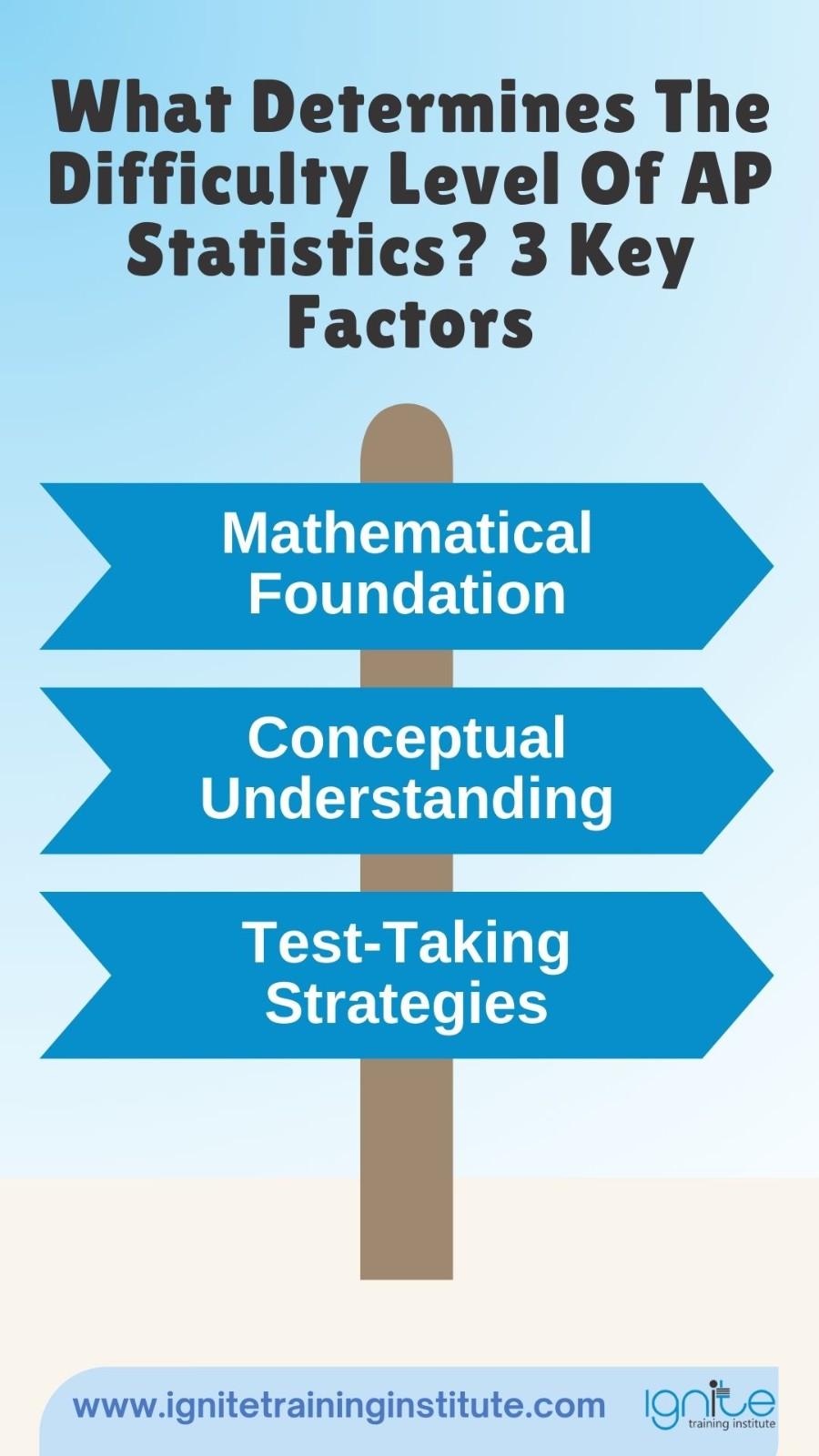
The AP Statistics course is designed to introduce students to the fundamental concepts of statistics and data analysis. While many students find it engaging and rewarding, others may struggle with its challenges. Understanding what influences the difficulty level of AP Statistics can help students prepare effectively. Here are three key factors that determine the difficulty level of this course:
1. Mathematical Foundation
AP Statistics requires a solid understanding of mathematical concepts, particularly those related to algebra and basic probability. Students must be comfortable with:
- Algebraic Manipulations: Skills in solving equations and manipulating algebraic expressions are crucial.
- Graphing: Ability to interpret and create various types of graphs, including scatterplots, histograms, and box plots.
- Probability: Understanding basic probability rules, including independent and dependent events, can significantly affect how students approach statistical problems.
A weak mathematical foundation can make the course challenging, as many statistical concepts build upon these skills.
2. Conceptual Understanding
Statistics is not just about numbers; it’s also about understanding concepts and interpretations. The difficulty can stem from:
- Abstract Thinking: Students need to grasp abstract concepts like variability, sampling distributions, and confidence intervals. This requires a shift from concrete mathematical operations to more conceptual reasoning.
- Data Interpretation: Analyzing real-world data and drawing conclusions based on that data is essential. Students must develop the ability to interpret statistical results in context, which can be challenging if they struggle with conceptualization.
Students who approach statistics with a conceptual mindset tend to perform better, while those focused solely on computations may find themselves confused by the course’s expectations.
3. Test-Taking Strategies
Success in AP Statistics is not only about understanding the material; it also involves effective test-taking strategies:
- Multiple-Choice Questions: The AP exam features a significant number of multiple-choice questions, which often require students to apply their knowledge quickly and accurately. Developing strategies to eliminate incorrect options can enhance performance.
- Free Response Questions: These questions test a deeper understanding of statistical concepts. Students must articulate their reasoning and demonstrate their problem-solving process, which can be daunting for those unfamiliar with writing mathematical arguments.
- Time Management: Balancing time during the exam is crucial. Students need to practice pacing themselves to ensure they can complete all questions without rushing.
Related: How To Register For AP Exams? Deadline 2024
What Is The Passing Rate For AP Statistics Students?
AP Statistics is a popular choice for high school students looking to gain college credit and enhance their analytical skills. The passing rate, which refers to the percentage of students who score a 3 or higher on the AP Statistics exam, can vary from year to year but generally provides insight into the exam’s overall difficulty and student performance.
In recent years, the passing rate for AP Statistics students has typically ranged between 55% to 60%. This means that over half of the students who take the exam score a 3 or higher, which is generally considered a passing score by most colleges and universities. In 2023, for example, approximately 58.3% of students passed the exam.
Factors Affecting The Passing Rate:
- Preparation Level: Students who take rigorous coursework and engage in consistent practice tend to perform better.
- Quality Of Instruction: Access to experienced teachers who can explain complex statistical concepts is crucial for success.
- Exam Difficulty: The passing rate can also fluctuate depending on the difficulty of the exam in a given year.
Related: AP Biology: Course Overview, Assessment & 2024 Exam Dates
What Does AP Statistics Cover & Is It Worth It?
AP Statistics covers key topics such as data exploration, sampling methods, probability, and statistical inference. It equips students with essential analytical skills and offers the potential for college credit. Taking the course enhances college readiness and competitiveness in various fields, making it a valuable choice for many students.
Overview Of AP Statistics
AP Statistics is a college-level course for high school students, focusing on statistical reasoning and data analysis. The curriculum covers four major themes:
- Exploring Data: Understanding and summarizing data through measures like mean and standard deviation, along with graphical representations.
- Sampling And Experimentation: Learning about sampling methods and designing experiments to gather reliable data.
- Anticipating Patterns: Covering probability concepts and the Central Limit Theorem to understand sampling distributions.
- Statistical Inference: Building skills in constructing confidence intervals and hypothesis testing.
Is It Worth It?
- College Credit: Many colleges award credit for a score of 3 or higher on the AP exam, saving time and tuition costs.
- Skill Development: It fosters strong analytical skills useful in various fields such as business, healthcare, and social sciences.
- Preparation For College: The course prepares students for the rigor of college-level work, enhancing their critical thinking and problem-solving abilities.
- College Admissions: It demonstrates academic challenge on college applications, making students more competitive.
- Interest In STEM: Provides a foundation for students considering majors in math, economics, or related fields.
Related: AP Exam Test Dates 2024: A Student’s Guide To Strategize
What Is AP Statistics Equivalent To?
AP Statistics is a college-level course offered in high school that focuses on statistical concepts and methodologies. This course serves as an introduction to the field of statistics and provides students with the foundational knowledge necessary for more advanced studies in data analysis and interpretation.
When considering what AP Statistics is equivalent to, it’s essential to look at several aspects: other high school courses, college courses, and standardized testing.
High School Course Equivalents
- Statistics Courses: Many high schools offer standalone statistics courses that cover similar material to AP Statistics. These courses typically introduce students to descriptive statistics, inferential statistics, probability, and data analysis but may lack the depth and rigor found in AP Statistics.
- Mathematics Courses: While AP Statistics is primarily a statistics course, it may also be viewed as an alternative to advanced mathematics courses, such as Pre-Calculus or Calculus. Students who are more interested in data and probability may find AP Statistics to be more relevant and applicable than traditional calculus.
College Course Equivalents
- Introductory Statistics: At the college level, AP Statistics is generally equivalent to an introductory statistics course. Most colleges recognize a score of 3 or higher on the AP Statistics exam for college credit, allowing students to bypass the introductory statistics course required in many degree programs.
- Data Analysis Courses: Some colleges offer specific courses focusing on data analysis, which can include components of AP Statistics. These courses often emphasize practical applications of statistical concepts, aligning closely with the AP curriculum.
Standardized Testing
- SAT Subject Tests: Although the SAT Subject Tests are no longer offered, AP Statistics could be viewed as equivalent to certain quantitative sections in standardized testing, where data interpretation and analysis skills are critical.
- College Placement Tests: Many colleges use placement tests to assess students’ readiness for mathematics and statistics courses. AP Statistics can prepare students for these tests, as it covers essential concepts that may appear in these assessments.
Related: AP Courses & Exams: Complete List For High Schoolers
When Should You Take AP Statistics?
AP Statistics is an advanced placement course designed to introduce students to the concepts and tools of statistical analysis. It provides a solid foundation for students interested in pursuing fields such as mathematics, social sciences, economics, and natural sciences. Here are key factors to consider when deciding the right time to take AP Statistics:
1. Prerequisites And Math Background
- Algebra Proficiency: Before enrolling in AP Statistics, students should be comfortable with algebra. A solid understanding of algebraic concepts is essential for grasping statistical methods and calculations.
- Previous Math Courses: It’s advisable to have completed courses like Algebra II or Pre-Calculus. These courses typically cover the necessary mathematical skills required for AP Statistics.
2. Grade Level
- Junior Or Senior Year: Most students take AP Statistics during their junior or senior year of high school. By this time, they are usually ready for the rigor of an AP course and have developed better analytical and critical thinking skills.
- Sophomore Year: Some schools may allow motivated sophomores to enroll in AP Statistics, especially if they have excelled in math courses.
3. Interest And Career Goals
- Career Aspirations: Students interested in fields such as psychology, sociology, business, or data science will benefit significantly from taking AP Statistics. If these fields align with your future goals, taking the course sooner rather than later can provide a competitive edge.
- Personal Interest: If you have a strong interest in data analysis, research, or real-world applications of math, taking AP Statistics can enhance your understanding and enjoyment of the subject.
4. Course Load Consideration
- Balancing Courses: It’s essential to consider your overall course load. AP Statistics is challenging, and it’s important to balance it with other AP or honors courses. Ensure you can dedicate enough time to study and complete assignments without overwhelming yourself.
- Extracurricular Activities: If you are involved in extracurricular activities, consider how they might affect your ability to manage coursework. A well-structured schedule will help you succeed in both academics and other interests.
5. Teacher Recommendations
- Consult Your Math Teacher: If you’re unsure whether you’re ready for AP Statistics, speak with your current math teacher. They can provide valuable insights based on your performance in previous math courses and suggest whether you should consider taking the class.
6. Preparation Resources
- Summer Preparation: If you decide to take AP Statistics but feel you need a refresher on key concepts, consider using summer resources like online courses, textbooks, or tutoring to prepare in advance.
- AP Exam Consideration: Think about when you want to take the AP exam for Statistics. Most students take it in May, so planning your coursework around this timeline is crucial.
Related: Top 5 Easiest AP Exams: A Guide to Achieving Success
What Are the Prerequisites For Opting For AP Statistics?
Advanced Placement (AP) Statistics is a rigorous course designed for high school students who wish to gain a deeper understanding of statistics and data analysis. Before enrolling in AP Statistics, students should be aware of the prerequisites to ensure they are adequately prepared for the challenges of the course.
Here are the key prerequisites for opting for AP Statistics:
1. Mathematical Foundation
- Algebra Proficiency: A strong foundation in algebra is essential. Students should be comfortable with algebraic expressions, equations, and functions. This includes understanding linear equations, inequalities, and basic algebraic manipulation.
- Understanding Of Functions: Familiarity with different types of functions (linear, quadratic, etc.) is important, as statistical concepts often involve functional relationships.
2. Previous Mathematics Courses
- Completion Of A Pre-Calculus Course: While not always mandatory, completing a pre-calculus course is highly recommended. This course provides the necessary mathematical skills and prepares students for the abstract concepts encountered in AP Statistics.
- Geometry Knowledge: A solid understanding of geometric concepts can be beneficial, particularly when dealing with graphical representations of data.
3. Analytical Thinking Skills
- Critical Thinking: Students should possess strong analytical and critical thinking skills. The ability to interpret data, identify patterns, and draw conclusions from statistical analyses is crucial in this course.
- Problem-Solving Ability: A knack for solving problems and applying mathematical concepts to real-world situations will enhance a student’s experience in AP Statistics.
4. Statistical Literacy
- Familiarity With Basic Statistical Concepts: While AP Statistics will cover many topics in-depth, having a basic understanding of fundamental statistical concepts (such as mean, median, mode, and basic probability) can provide a helpful foundation.
5. Interest And Motivation
- Enthusiasm For Learning Statistics: A genuine interest in statistics and its applications can motivate students to engage deeply with the course material. Students who are curious about how data influences decisions in various fields will likely find the course rewarding.
6. Study And Time Management Skills
- Commitment to Coursework: AP Statistics requires a commitment to studying and completing assignments on time. Strong time management skills will help students balance this rigorous course with other academic responsibilities.
Related: Do AP Classes Count As College Credit? All You Need To Know
What AP Statistics Scores Do You Need For College Credit?
To earn college credit for AP Statistics, most colleges typically require a score of 3 or higher, although some may require a score of 4 or 5 for advanced placement. Always check specific college policies, as requirements can vary by institution.
Projects
When students take the AP Statistics exam, their primary goal often revolves around earning college credit or placement. Most colleges and universities offer credit or advanced placement based on the AP exam scores, allowing students to save time and money in their college education.
It’s crucial to understand the specific score requirements of your target institutions, as these can vary significantly.
Areas
- Score Requirements:
- Generally, a score of 3 or higher on the AP Statistics exam is commonly accepted for college credit at many institutions. However, some colleges may require a score of 4 or 5 for more advanced placement or credit.
- It’s essential to check with individual colleges, as some might have specific policies or minimum score requirements that differ from the general trend.
- College Policies:
- Many public universities and community colleges have standardized policies regarding AP exam scores. For instance, the College Board provides a detailed chart of how various colleges recognize AP scores, including which score corresponds to college credit.
- Private institutions may have varying acceptance rates and could consider additional factors beyond AP scores, such as overall GPA and other standardized test scores.
- Course Equivalency:
- Institutions often assign AP Statistics scores to specific college-level courses. For example, a score of 4 might equate to an introductory statistics course, while a score of 5 could grant credit for a more advanced statistics class.
Resources
- College Board AP Credit Policy Search: The College Board offers an online tool where students can search for specific colleges and their AP credit policies. This resource can help students plan their AP course load effectively.
- Institutional Websites: Prospective students should regularly check the websites of their desired colleges for the most current AP credit policies, as these can change over time.
Archives
- Historical Trends: Over the years, the acceptance of AP Statistics scores for college credit has increased, reflecting the growing recognition of AP courses as rigorous college preparatory classes. Keeping track of past policies can help prospective students anticipate future trends and understand the evolving landscape of AP credit acceptance.
Related: A Complete Guide To What Is An AP Seminar Exam
Ignite Training Institute: Best AP Statistics Tutors In Dubai-
Ignite Training Institute is known for having the best AP Statistics tutors in Dubai, delivering expert guidance to help students excel in this challenging subject. The highly qualified instructors possess a deep understanding of statistical concepts and real-world applications, ensuring personalized attention tailored to each student’s learning style.
With a focus on interactive teaching methods and comprehensive resources, Ignite fosters a supportive learning environment that boosts confidence and improves performance. Whether preparing for the AP exam or enhancing statistical skills, students receive a top-quality education, setting them up for academic success.
Related: The Difficulty of AP Exams & Classes: What to Expect
FAQs
1. How Hard Is AP Statistics?
AP Statistics is considered moderately challenging, as it requires a solid understanding of statistical concepts, data analysis, and critical thinking.
2. Is AP Stats An Easy A?
Many students find AP Statistics manageable if they engage with the material and practice regularly, potentially making it an “easy A” for those who are committed.
3. Is AP Statistics Easier Than Calculus?
Generally, students find AP Statistics to be easier than AP Calculus because it focuses more on practical applications rather than complex mathematical theories.
4. Is It Easy To Get A 5 On AP Statistics?
While achieving a 5 on the AP Statistics exam is challenging, it is feasible with diligent study, understanding the content, and effective exam strategies.
5. Is 75% A 5 On AP Exams?
Typically, a score of 75% may not guarantee a 5 on AP exams, as the scoring is relative and can vary by year and subject.
6. What Is The Easiest AP Class To Score A 5?
AP classes like AP Environmental Science and AP Psychology are often cited as easier for students to achieve a 5, depending on individual strengths and interests.
7. Can I Self-Study For AP Stats?
Yes, many students successfully self-study for AP Statistics using textbooks, online resources, and practice exams.
8. Is The AP Stats Exam Curved?
The AP Statistics exam is not curved in a traditional sense; however, the scoring is scaled based on overall performance to ensure fairness across different test administrations.
9. What Is The 5% Rule In AP Stats?
The 5% rule in AP Statistics refers to a guideline for determining whether to use a normal approximation for a binomial distribution, typically applied when both npnpnp and n(1−p)n(1-p)n(1−p) are greater than 5.
10. What Is The Difficulty Rating For AP Stats?
The difficulty rating for AP Statistics is often rated as moderate to difficult, reflecting its balance of conceptual understanding and practical application.
Conclusion

In conclusion, whether AP Statistics is considered easy largely depends on a student’s background and approach to the material. While some may find the concepts of data analysis and statistical reasoning more intuitive than the complexities of calculus, others may struggle with the application of these principles in real-world scenarios.
Success in AP Statistics requires consistent effort, effective study habits, and a willingness to engage with the content. With the right mindset and resources, many students can navigate the course successfully and even find it to be an enjoyable challenge, paving the way for a solid foundation in statistical literacy.
Related: All About AP Exams 2025 Explained: A Detailed Overview