Navigating the IGCSE grading system can be a daunting task for students and parents alike. The International General Certificate of Secondary Education (IGCSE) uses a grading scale from A* to G, with A* being the highest grade and G the lowest.
Each grade reflects a student’s performance, knowledge, and skills in a specific subject area. Understanding these grades is crucial for setting realistic academic goals and planning future educational pathways.
At Ignite Training Institute, we specialize in providing comprehensive tutoring support for the IGCSE curriculum. Our experienced IGCSE tutors are dedicated to helping students achieve their academic potential by offering personalized lessons and targeted exam preparation strategies.

What Is IGCSE Grading System?
The IGCSE (International General Certificate of Secondary Education) grading system for 2025 maintains the use of both the traditional A*-G scale and the newer 9-1 scale. These grading scales are designed to provide a fair and comprehensive assessment of student’s performance across a range of subjects.
Traditional A*-G Grading Scale
The traditional grading scale, recognized globally, is as follows:
- *A (90-100%)**: Exceptional performance
- A (80-89%): Excellent performance
- B (70-79%): Good performance
- C (60-69%): Satisfactory performance
- D (50-59%): Fair performance
- E (40-49%): Sufficient performance
- F (30-39%): Poor performance
- G (20-29%): Very poor performance
- U (0-19%): Ungraded, indicating that the minimum standards required for grade G were not met
This scale is widely used and accepted by educational institutions and employers worldwide. It allows for a clear differentiation of student performance across various levels of understanding and proficiency.
9-1 Grading Scale
In response to changes in the UK GCSE system, the IGCSE has also introduced a 9-1 grading scale in some regions, particularly in the UK. This scale offers more granularity at the higher end of the grading spectrum:
- 9 (highest grade): Indicates exceptional performance, surpassing the old A* grade
- 8: Roughly equivalent to an A* in the traditional scale
- 7: Corresponds to an A
- 6: Aligns with a high B
- 5: Matches a low B/high C
- 4: Equivalent to a low C
- 3: Comparable to a D/E
- 2: Equivalent to an F
- 1 (lowest grade): Comparable to a G
- U: Ungraded
The 9-1 scale is designed to provide finer distinctions among higher-achieving students, allowing for a more precise assessment of top-tier performance.
Related: 10 Easiest IGCSE Subjects In 2024 For Academic Excellence
What Is The IGCSE Passing Mark?
In the International General Certificate of Secondary Education (IGCSE) grading system, the passing mark varies depending on the grading scale used. Traditionally, IGCSE grades range from A* to G, with A* being the highest. In this scale, a grade of G is considered the minimum passing grade, indicating a basic understanding of the subject matter.
However, many educational institutions consider a grade of C or above as a satisfactory pass, reflecting a more comprehensive understanding of the subject.
In regions where the 9–1 grading scale is adopted, the passing threshold can vary, but a grade 4 is generally considered a standard pass, while a grade 5 is viewed as a strong pass. It’s important to note that specific passing requirements may vary by institution and country.
Related: Is O Level And IGCSE The Same? Differences & How To Choose
What Is Cambridge Grading System?
The Cambridge grading system is used to assess student performance in Cambridge IGCSE and other Cambridge International qualifications. For IGCSE, students are graded from A to G*, where A is the highest* and G is the lowest passing grade. A grade of U (ungraded) means the required standard was not met.
Some schools also follow the 9–1 grading scale, with 9 being the highest and 4 generally considered a standard pass. Grades are determined based on a combination of coursework, practicals, and written exams, using grade thresholds set by Cambridge for each subject and exam session.
Related: AQA VS CIE: A Closer Look Into The Examination Boards
What Are Edexcel Grade Boundaries?
Edexcel grade boundaries are thresholds set by the Pearson Edexcel examination board to determine the grades students receive based on their exam performance. These boundaries are essential in categorizing student performance into various grades, ensuring fairness and consistency across different exam sessions.
How Edexcel Grading Works?
GCSEs Grades:
- Grades 9 to 1: Edexcel uses a numerical grading scale where 9 is the highest grade, representing exceptional performance, and 1 is the lowest, indicating the minimum level of achievement.
- Grade 9: Exceptional performance, above the old A*.
- Grades 8 and 7: Correspond to the old A* and A grades.
- Grade 1: Minimum threshold of achievement.
A Levels Grades:
- Grades A to E*: The traditional letter grading system is used.
- Grade A*: Superior grasp of the subject, higher than an A.
- Grades A to E: Range from excellent to satisfactory understanding.
- Grade E: Minimum passing grade.
Related: Old & New GCSE Grading System: All You Need To Know
What Is AQA Grading System?
The Assessment and Qualifications Alliance (AQA) employs the reformed 9–1 grading system for General Certificate of Secondary Education (GCSE) examinations in England, introduced in 2017. In this system, Grade 9 represents the highest level of achievement, surpassing the former A* grade, and is designed to distinguish exceptional performance.
The scale continues down to Grade 1, which aligns with the old G grade, indicating the minimum level of achievement within the qualification’s requirements. A Grade 4 is generally considered a standard pass, comparable to the previous C grade, while a Grade 5 is viewed as a strong pass, positioned between the old B and C grades.
This numerical grading structure provides greater differentiation among student performances, particularly at the higher end of the spectrum.
AQA determines grade boundaries—the minimum number of marks required for each grade—after all exam papers have been marked. Senior examiners and assessment experts set these boundaries annually, considering the relative difficulty of the exam papers and overall student performance to maintain consistent standards year over year.
This process ensures that a student’s grade reflects their performance relative to the specific challenges of that year’s examinations.
Related: 10 Proven Strategies On How To Study For IGCSE Exams & Excel
How Are IGCSE Grades Determined?
IGCSE grades are determined through a comprehensive process designed to ensure fairness, consistency, and accuracy in assessing student performance. This process involves several key steps:
1. Setting Exam Papers
- Content Development: Subject experts and educators develop exam papers to cover the curriculum comprehensively, ensuring that questions assess a range of skills and knowledge areas.
- Review and Approval: Exam papers undergo multiple reviews to ensure they meet the required standards of difficulty and clarity.
2. Conducting Exams
- Examination Period: Students sit for exams under controlled conditions, which typically occur in two sessions: May/June and October/November.
- Invigilation: Exams are invigilated to maintain integrity and prevent malpractice.
3. Marking
- Examiners: Qualified and trained examiners mark the papers. Examiners are often teachers or subject experts who follow strict marking guidelines.
- Standardization: To ensure consistency, a process called standardization takes place. Senior examiners review a sample of marked scripts to confirm that all examiners are applying the marking criteria consistently.
4. Setting Grade Boundaries
- Statistical Analysis: Grade boundaries are set using a combination of statistical data and expert judgment. This ensures that the distribution of grades remains consistent with previous years.
- Expert Judgment: Senior examiners and subject experts analyze the performance data and consider the difficulty of the exam papers to set appropriate grade boundaries.
- Review of Previous Performance: Historical data and past student performance trends are also taken into account to maintain continuity and fairness in grading.
5. Awarding Grades
- Conversion to Grades: Marks are converted into grades based on the set grade boundaries. For example, if the boundary for a grade A is 80%, any student scoring 80% or above will receive an A.
- Verification: The final grades are verified to ensure accuracy before being released to schools and students.
Grading Scales
- A-G Scale*: The traditional grading scale used by many schools globally. Grades range from A* (highest) to G (lowest), with U indicating ungraded.
- 9-1 Scale: A newer grading scale is used in some regions, particularly the UK. This scale provides more differentiation at the top end, with 9 being the highest grade.
Reporting Results
- Statements of Results: Students receive a statement of results, which includes their grades and sometimes the percentage uniform mark. This mark shows where the student falls within the grade band and provides additional context for their performance.
- Certificates: Official certificates are issued to students who meet the criteria for their courses.
Related: IGCSE Subjects Choices: Navigate Your Options For The Future
Is D A Passing Grade In IGCSE?
In the context of IGCSE (International General Certificate of Secondary Education) exams, a grade of D is generally considered a passing grade, but it is important to understand its implications and acceptance in various contexts.
Understanding IGCSE Grade D
- Grading Scale: The IGCSE grading scale traditionally ranges from A* to G, with U indicating ungraded. The grades are often interpreted as follows:
- A to C*: These grades are typically viewed as strong passes and are often required for progression to higher education or further study.
- D to G: These are considered passing grades but are seen as lower passes. They indicate that the student has achieved a basic understanding of the subject matter but may not have met the higher standards set by the institution for further study.
Is Grade D Considered A Pass?
- Passing Threshold: In many educational systems, a grade D is considered a pass, indicating that the student has met the minimum criteria to pass the course. This means that the student has demonstrated sufficient knowledge and skills in the subject to receive a grade rather than being ungraded.
- Higher Education and Employment: The acceptance of a grade D can vary significantly:
- Further Education: Many universities and colleges typically require higher grades (A* to C) for entry into more advanced courses. A grade D might not meet the entry requirements for some institutions or specific courses.
- Employment: Some employers may consider a grade D as a pass, but higher grades are generally preferred, especially in competitive job markets.
Contextual Considerations
- Course Requirements: Certain courses or programs may have specific grade requirements. For example, a student wishing to study a subject at A-level or equivalent might need to achieve at least a C in the related IGCSE subject.
- International Recognition: The perception of a grade D can vary internationally. While it is a pass, its value and acceptance depend on the specific requirements of educational institutions and employers in different countries.
Related: What Is AQA GCSE: A Detailed Overview For Students & Parents
How Can IGCSE Grades Impact University Admissions?
IGCSE grades can significantly impact university admissions as they are often used as a measure of a student’s academic ability and potential. Many universities require students to achieve a certain grade in specific IGCSE subjects to be considered for admission to their programs.
For example, top universities in the UK, such as Oxford and Cambridge, typically require students to achieve A* grades in relevant IGCSE subjects to be considered for admission. Other universities may require a minimum grade of B or C in certain IGCSE subjects, depending on the program and level of competition for admission.
In addition, IGCSE grades can also be used to determine eligibility for scholarships and other financial assistance programs offered by universities. Students with outstanding IGCSE grades may be eligible for merit-based scholarships or other forms of financial support to help them pursue their academic goals.
Related: Top Universities That Accept IGCSE Certificate In USA & UK
How To Convert IGCSE Grades To Percentages?
Converting IGCSE grades into percentages can vary depending on the country or educational institution. However, one common method for converting IGCSE grades into percentages is by using the following table:
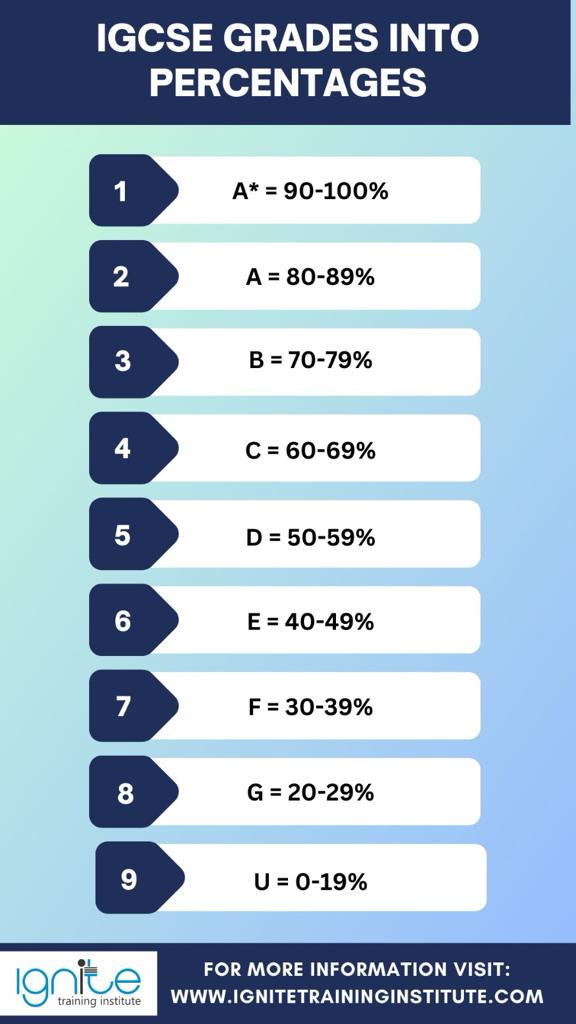
A* = 90-100%
A = 80-89%
B = 70-79%
C = 60-69%
D = 50-59%
E = 40-49%
F = 30-39%
G = 20-29%
U = 0-19%
For example, if a student receives an A grade in IGCSE Mathematics, the percentage equivalent would be between 80-89%. Similarly, if a student receives a C grade in IGCSE English, the percentage equivalent would be between 60-69%.
It’s important to note that this is just one method for converting IGCSE grades into percentages, and other methods may be used depending on the educational institution or country.
What Are Some Common Misconceptions About IGCSE Grades?
There are several common misconceptions about IGCSE grades that can lead to confusion or misunderstanding. Here are some of the most common misinterpretations:
- IGCSE Grades Are Not Recognized By Universities: This is not true, as IGCSE grades are widely recognized by universities around the world. In fact, many top universities require students to achieve certain grades in specific IGCSE subjects to be considered for admission.
- IGCSE Grades Are Easier To Achieve Than Other Qualifications: While IGCSE exams may be perceived as easier by some students, the grading standards for IGCSE are set to be comparable to other international qualifications such as GCSE or the International Baccalaureate (IB). Achieving top grades in IGCSE exams requires hard work and dedication.
- IGCSE Grades Do Not Matter For Future Academic Or Career Success: This is not true, as IGCSE grades can have a significant impact on future academic and career opportunities. Strong IGCSE grades can open up many doors for students, including access to top universities and scholarships.
- IGCSE Grades Are Only Relevant For Students In International Schools: IGCSE exams are available to students around the world, not just those in international schools. In fact, many local schools in countries such as the UK and India offer IGCSE programs as an alternative to national qualifications.
- IGCSE Grades Are Not Reliable: The grading standards for IGCSE are set by Cambridge Assessment International Education (CAIE), a reputable and independent organization that has been providing international assessments for over 150 years. The IGCSE grading system is designed to be reliable and consistent across different subjects and countries.
Related: IGCSE Computer Science: Syllabus Overview & Paper Details
Tips For Achieving Top Grades In IGCSE
Here are some tips for achieving top grades in IGCSE.
- Start studying early and maintain a consistent study schedule.
- Take good notes in class and review them regularly.
- Practice past exam papers to get a feel for the exam format and types of questions.
- Use study aids like flashcards and mind maps to aid memorization.
- Maintain a well-organized approach and stay on top of significant deadlines and tasks.
- Develop a deep understanding of key concepts rather than just memorizing information.
- Attend after-school or extra help sessions with teachers when needed.
- Avoid cramming or pulling all-nighters before exams.
- Ensure your well-being by obtaining sufficient sleep, engaging in physical activities, and consuming nutritious meals.
- Stay motivated and stay focused on your long-term goals.
Related: 10 Proven Strategies On How To Study For IGCSE Exams & Excel
FAQs
1. What Is Grade 11 Called In IGCSE?
In the IGCSE system, Grade 11 typically refers to Year 12, which is usually the first year of A-Levels or equivalent post-IGCSE study, depending on the school curriculum.
2. What Are The GCSE Grades 1 To 9?
GCSE grades 9 to 1 are part of the UK grading system, with 9 being the highest and 1 the lowest. A grade 4 is considered a standard pass, while 5 is a strong pass.
3. How To Calculate IGCSE Marks?
IGCSE marks are calculated by combining scores from coursework, practicals (if any), and final exams. Each component has a weightage, and the total raw marks are converted to a percentage and grade using grade thresholds set by Cambridge or Edexcel.
4. What Grade Is 70% In IGCSE?
In the IGCSE grading system, a score of 70% typically corresponds to a grade B.
5. What Is The Highest Grade In IGCSE?
The highest grade in IGCSE is A* on the A*-G scale, or 9 on the 9–1 scale, both indicating exceptional performance.
6. Is B A Good Grade In IGCSE?
Yes, a B is a good grade in IGCSE. It reflects above-average understanding and is widely accepted by schools and universities.
7. What Are The IGCSE Grade Levels?
IGCSE grade levels range from A* to G in the traditional grading scale, where A* is the highest and G is the lowest passing grade. In the newer 9-1 scale, grades range from 9 (highest) to 1 (lowest), with U indicating ungraded in both systems.
8. What Are Good IGCSE Grades?
A to C* grades in IGCSE are considered strong passes, crucial for advancing to higher education or further studies, reflecting comprehensive understanding and mastery of the subjects.
Conclusion

In conclusion, the IGCSE grading system plays a critical role in assessing students’ academic performance and preparing them for further education or employment. While achieving top grades can be challenging, it is essential for students who wish to pursue higher education and excel in their careers.
By understanding the grading system, setting realistic goals, and adopting effective study habits, students can achieve their desired grades and set themselves up for success in the future. It is important for students, parents, and educators to stay informed about the latest developments in the IGCSE program and to work together to support students in their academic journey.
Related: Edexcel IGCSE Biology Syllabus – A Student’s Critical Guide